Packaging Inserts: Types, Examples and How to Choose the Right One
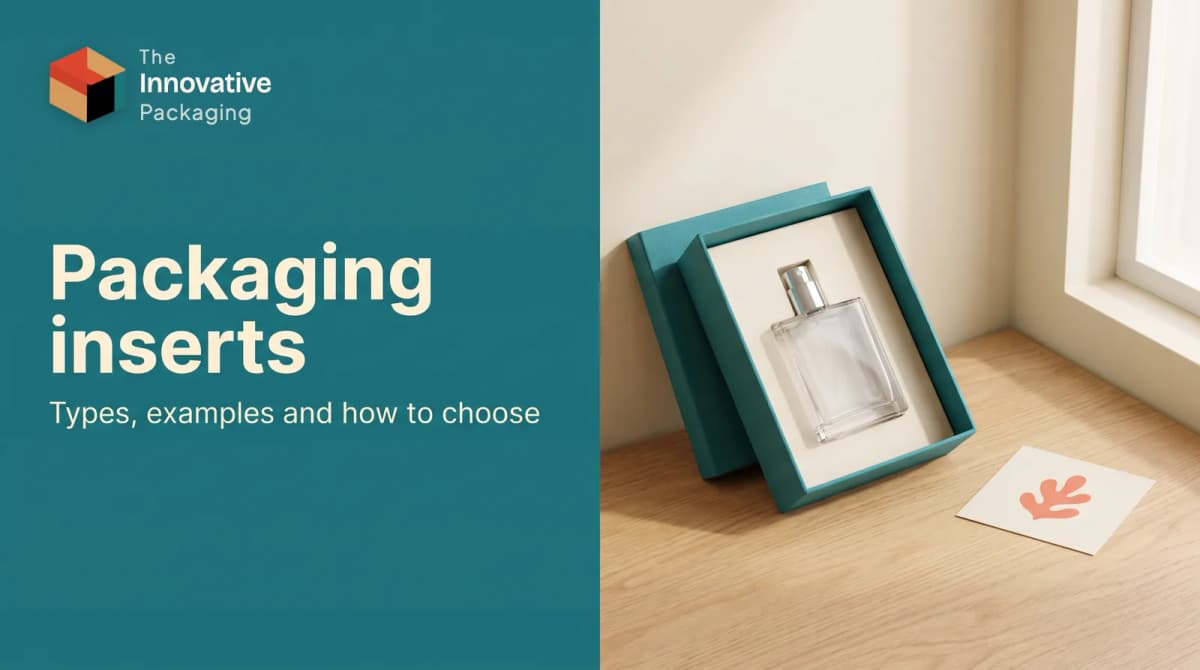
Packaging inserts are the parts inside a box that hold the product in place or carry a printed message. Protective inserts, made from paperboard, corrugated board, foam or molded pulp, stop the product from moving. Printed inserts, such as thank-you cards and instruction sheets, speak to the customer once the box is open.
A box used to have one job: get the product there in one piece. That is still the baseline, and the insert does most of that work. But the insert is also the first thing a customer sees when the lid comes off, so it shapes how the product is presented and what the customer does next. This guide covers the main types of packaging inserts, examples by product, how to choose one and the mistakes to avoid.
What do packaging inserts do?
An insert does one or both of two jobs:
- It holds the product. Much of the damage in a box comes from movement. A glass bottle that can slide strikes the box wall every time the parcel is dropped or turned over. An insert cut to the product keeps it centered and still, so the outer box takes the knocks instead.
- It presents the product. The insert decides what the customer sees first: a bottle standing upright, a set of shades in a neat row or a single item resting in a cut tray. A loose product in an empty box looks unfinished, however good the box is.
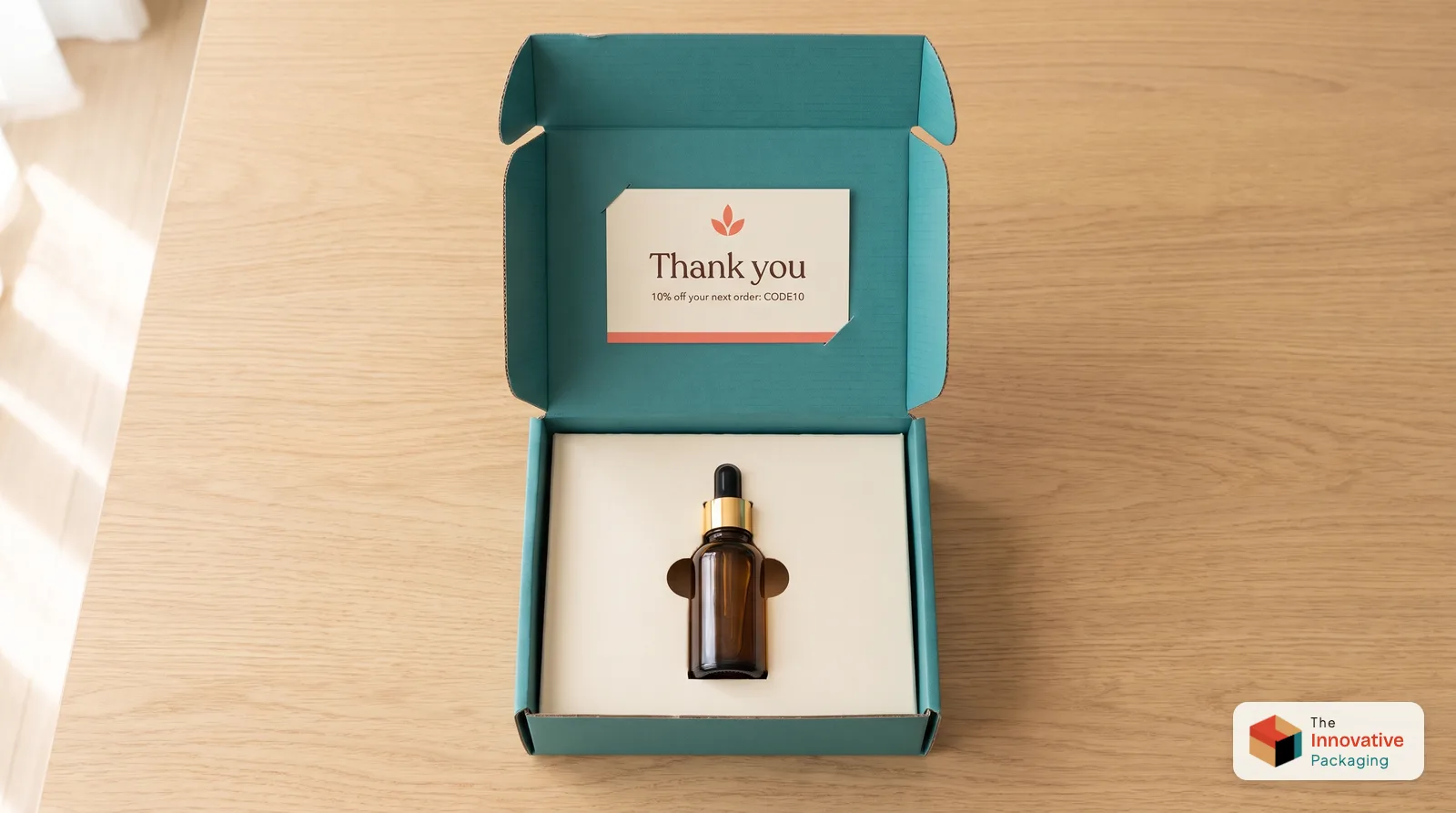
Printed inserts add a third job: they talk to the customer. A card can thank them, explain how to use the product or give them a reason to order again.
What are the main types of protective inserts?
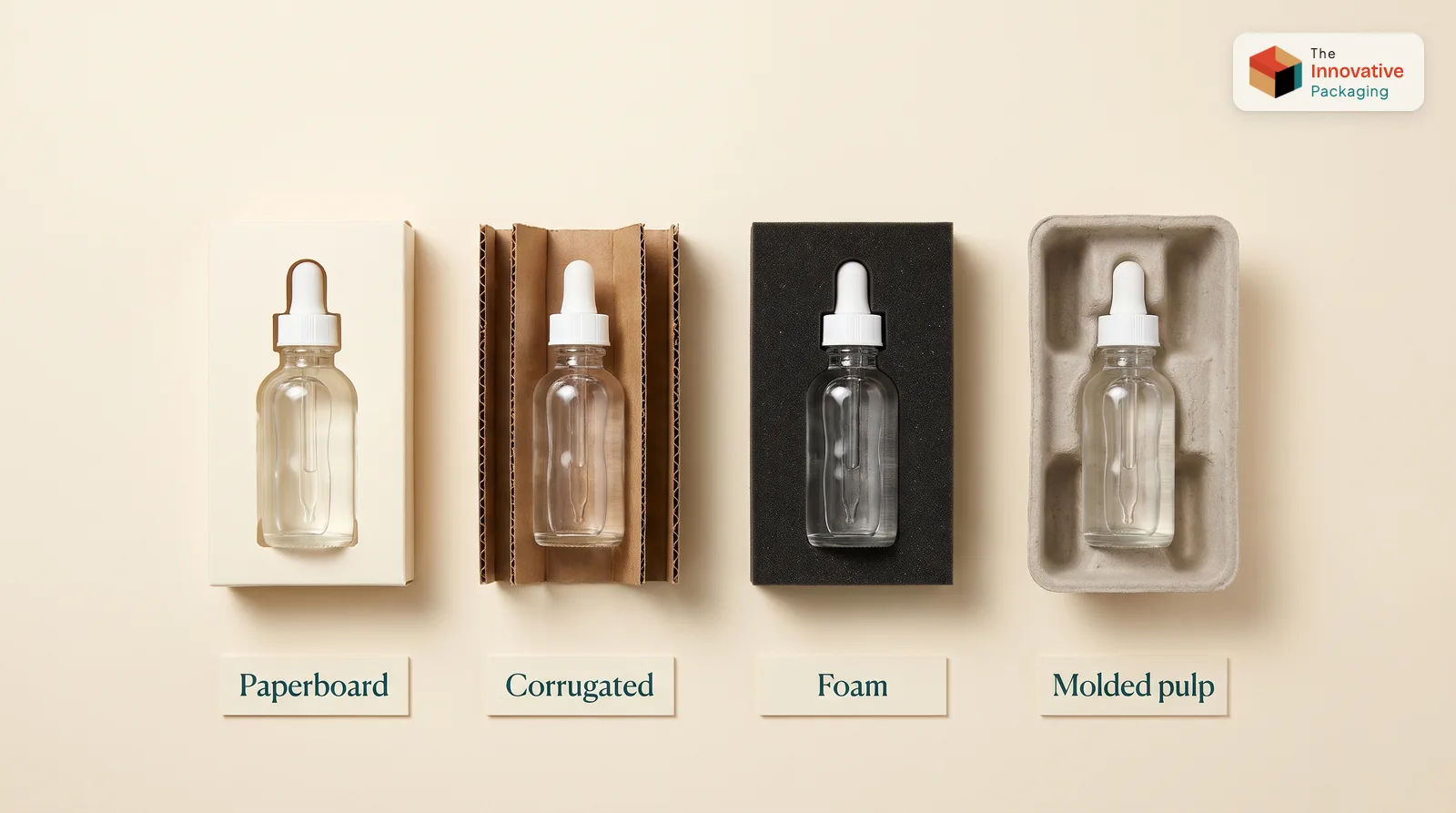
The material decides how much protection an insert gives, how it looks and what happens to it after the box is opened.
| Material | How it holds the product | Best for | After use |
|---|---|---|---|
| Paperboard | Die-cut and folded into cradles, slots and channels | Light products: cosmetics, serums, cartridges, syringes | Recycles with paper |
| Corrugated board | Fluted board cut into partitions, trays and pads | Heavier items, bottles and shipping boxes | Recycles with cardboard |
| Foam | Cut or molded to the exact product profile | Fragile or high-value items, glass and electronics | Rarely accepted in curbside recycling |
| Molded pulp | Paper fiber pressed into a shaped tray | Bottles, jars and devices that need a shaped cavity | Check with your supplier before making a claim |
Paperboard is a common choice for retail boxes. It can often be cut from the same board as the box, so it matches the printing and keeps the whole pack in one material.
Corrugated board is stronger and is widely recycled. In 2024, 69 to 74 percent of the cardboard available for recovery in the US was recycled (American Forest & Paper Association).
Foam gives the closest fit and the softest landing, which is why it is common for glass and electronics. The trade-off is disposal. Expanded polystyrene foam, the white beaded kind, is not accepted in most curbside recycling programs in the US (The Recycling Partnership). If your customers care about waste, a paper-based insert is usually the safer choice.
Molded pulp sits between the two. It holds a shaped product almost as closely as foam, with a natural, textured look.
Common insert styles
Whatever the material, most inserts take one of a few shapes:
- Cradle or die-cut slot: a raised panel with a cutout that holds one product upright.
- Punch partition: a panel with holes punched to the product shape, common for jars and tapered bottles. See our custom punch partitions.
- Fence partition: slotted dividers that form a grid of cells, used for multipacks and sets. See our custom fence partitions and, for bottles that travel together, our glass carriers.
- Recessed tray: a tray with a separate cavity for each item in a kit, such as a device, a cable and a cartridge.
- Four-corner tray: a shallow tray that lifts the product off the box wall so it is suspended rather than resting against it.
What should a printed insert card say?
A printed insert costs little, and it reaches a customer who has already bought from you and is holding your product. Give it one clear job.
The most useful job is usually bringing the customer back. In a 2025 survey of 1,376 online shoppers for the logistics company Ryder, a coupon, discount or credit toward a future purchase was the factor most likely to make a shopper buy from a brand again, chosen by 47 percent. A free sample came second at 24 percent (Packaging Dive).
Packaging insert ideas for printed cards:
- Thank-you cards that sound like your brand, ideally with a name and a short line rather than a paragraph.
- Discount or reorder cards with a code that is unique to the insert, so you can see how many customers use it.
- Instructions and care cards for products that need steps, such as skincare routines or devices.
- Sample cards that hold a sachet of a second product and explain why to try it.
- QR codes that link to a how-to video, a review page or a refill order.
Keep each card to one message and one action. A card that thanks the customer, lists five products and asks for a review usually gets none of them.
What are some packaging insert examples?
The right insert depends on the product's weight, shape and how it is sold. These are the combinations we see most often:
- Perfume: glass is heavy and fragile, so a cut insert holds the bottle centered and stops it striking the walls. It also controls the reveal, with the bottle presented upright when the lid comes off. See our custom perfume boxes.
- Vape cartridges: cartridges are light and slim, so they rattle in any box cut to a stock size. A foam or paperboard insert cut to the cartridge profile fixes that and doubles as a presentation tray, as in our custom printed vape cartridge boxes.
- Serums and dropper bottles: a folding carton alone will not absorb impact. A paperboard insert or a four-corner tray keeps the bottle off the box wall, which is what we recommend for glass in our serum boxes.
- Syringes: a long, thin syringe rolls in a loose box. A paperboard channel cut to the barrel holds it along its length and keeps the plunger from being knocked, as in our custom syringe boxes.
- CBD tinctures and creams: a punch partition holds a tapered jar or bottle still without loose filler. Brands ordering CBD boxes wholesale often use one insert style across a whole range.
- Chocolates: a punch partition or molded tray keeps each piece in place so they do not slide together and scuff. See our custom chocolate boxes.
- Dates and gift assortments: a partitioned tray keeps varieties apart and turns a box of fruit into a gift. Our custom dates boxes can be made with cells sized to the fruit.
- Bath bombs: they break from movement, not pressure. A fence partition seats each bomb in its own cell, as in our custom bath bomb boxes.
- Candles and gift sets: a cut insert holds a jar centered in a shaped box, such as our custom six corner gift boxes or custom candle boxes.
How do you choose the right packaging insert?
- Start with the product. Note its weight, its shape and how fragile it is. Glass and anything heavy needs a firmer hold than a light plastic tube.
- Decide how it travels. A box that ships alone through a carrier needs more protection than one that sits on a shelf or travels inside a shipping carton.
- Plan the opening. Decide what the customer should see first, and design the insert to present it that way.
- Size the insert before the box. The box is built around the insert, not the other way around, so both belong on the same dieline.
- Think about disposal. If you plan to print a recycling message, a paper-based insert keeps the whole pack in one material.
- Weigh the cost against the damage. An insert adds cost to every box. A broken product costs the item, the shipping both ways and often the customer. Our guide to how much to spend on packaging shows how to set a budget per unit.
If damage is already a problem, a lab can test the packed box to a standard such as ISTA 3A, which is designed for parcels shipped through carriers. Our guide to reducing returns from shipping damage covers the rest of the box.
What mistakes should you avoid with packaging inserts?
- Cutting to a drawing instead of the real product. Bottles, jars and caps vary slightly from batch to batch. Send us a finished unit of the product, so the cutout fits what you actually ship.
- A fit that is too tight. If the customer has to dig the product out, the reveal is lost and the insert may tear. Leave a finger notch or a lift tab.
- A fit that is too loose. A cutout with a few millimeters of play lets the product rattle, which defeats the purpose.
- Too many materials. A foam insert inside a paper box makes recycling harder for the customer and weakens any eco message.
- A crowded printed card. One message and one action works better than a card that tries to do everything.
Ordering custom packaging inserts
To quote a box with an insert, we need:
- The product, its dimensions and its weight, or a finished unit we can measure
- How many items go in each box
- How the box will be sold and shipped
- The box style and any printed cards you want included
- Roughly how many boxes you need
We build custom box inserts and the box together from one dieline, at no charge, with a digital proof before printing and a minimum of 100 units per style. Shipping is free anywhere in the USA. Request a free quote for custom boxes with inserts.
Founder & CEO, The Innovative Packaging · 10 years experience
Ijlal Ahmed founded The Innovative Packaging and runs its production facility in Pakistan. He is the third generation of his family in printing and packaging, a business they have been in for more than 50 years, and works directly with brands on quotes and dielines. He holds a BSc in Economics from the Lahore School of Economics.
Ijlal Ahmed on LinkedInFrequently Asked Questions
Shop the packaging in this guide
Custom Gift Boxes
Looking for premium custom gift boxes wholesale that make every unboxing memorable? At The Innovative Packaging, we craft custom gift packaging tailored to your brand, product dimensions, and presentation requirements. Whether you need packaging for corporate gifts, retail products, luxury items, or seasonal collections, we have a solution for every occasion.
Browse Custom Gift Boxes →CBD Boxes
Looking for high-quality custom CBD boxes wholesale that make your brand stand out? At The Innovative Packaging, we specialize in crafting premium CBD packaging boxes tailored to your exact product dimensions, branding, and compliance requirements. Whether you need packaging for CBD oils, tinctures, capsules, creams, soaps, or gummies, we have a solution for every product in your lineup.
Browse CBD Boxes →Custom Cosmetic Boxes
Looking for premium custom cosmetic boxes wholesale that make your beauty brand stand out? At The Innovative Packaging, we produce fully custom cosmetic packaging tailored to your exact product dimensions, branding, and retail requirements. Whether you need boxes for perfume, serum, lip gloss, hair products, essential oils, or face care kits, we have a packaging solution for every product in your beauty lineup.
Browse Custom Cosmetic Boxes →More from the blog
How to Prevent Shipping Damage and Reduce Returns With Better Packaging
A cracked bottle or a crushed corner turns a sale into a refund and a bad review. Here is how to prevent shipping damage and reduce returns with the right box size, custom inserts, stronger corrugated board, clear labels and a simple drop test.
Read more →How Much Should You Spend on Packaging? A Budget Guide for Small Brands
How much should you spend on packaging? There is no reliable magic percentage. Here is how to set a packaging budget from your own price and margin, with a worked example built on published figures and where to spend first.
Read more →Rigid Boxes vs Folding Cartons: Which One Is Worth the Cost?
Rigid boxes feel heavier and look more premium, but they cost more and ship assembled. Folding cartons ship flat and cost less. Here is how to choose, and how to make a folding carton feel premium on a smaller budget.
Read more →