Rigid Boxes vs Folding Cartons: Which One Is Worth the Cost?
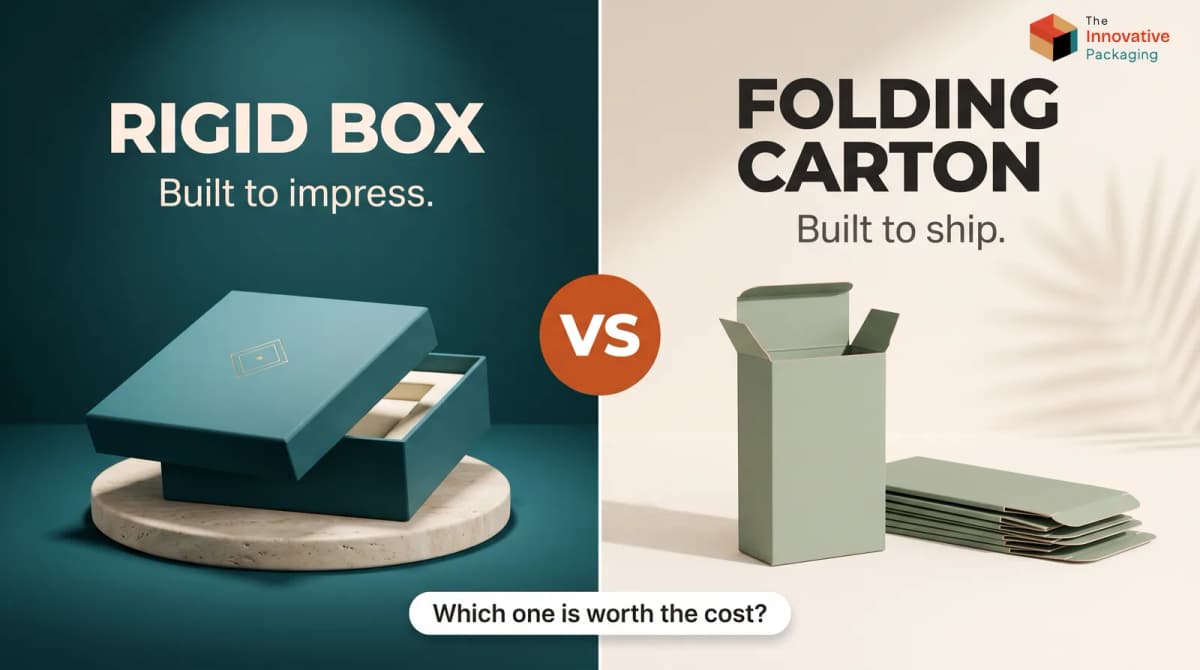
A rigid box is made from thick 1.5mm to 3mm chipboard wrapped in printed paper, and it arrives already built. A folding carton is made from much thinner paperboard, about 0.3mm to 0.6mm, and ships flat. Rigid boxes feel heavier and more premium but cost more per box. Folding cartons cost less, store easily and suit most retail products.
So which one is worth it for your brand? It depends on what you sell, what you charge for it, and how the box reaches your customer. Pick wrong and you either overspend on packaging or undersell a premium product.
What is a rigid box?
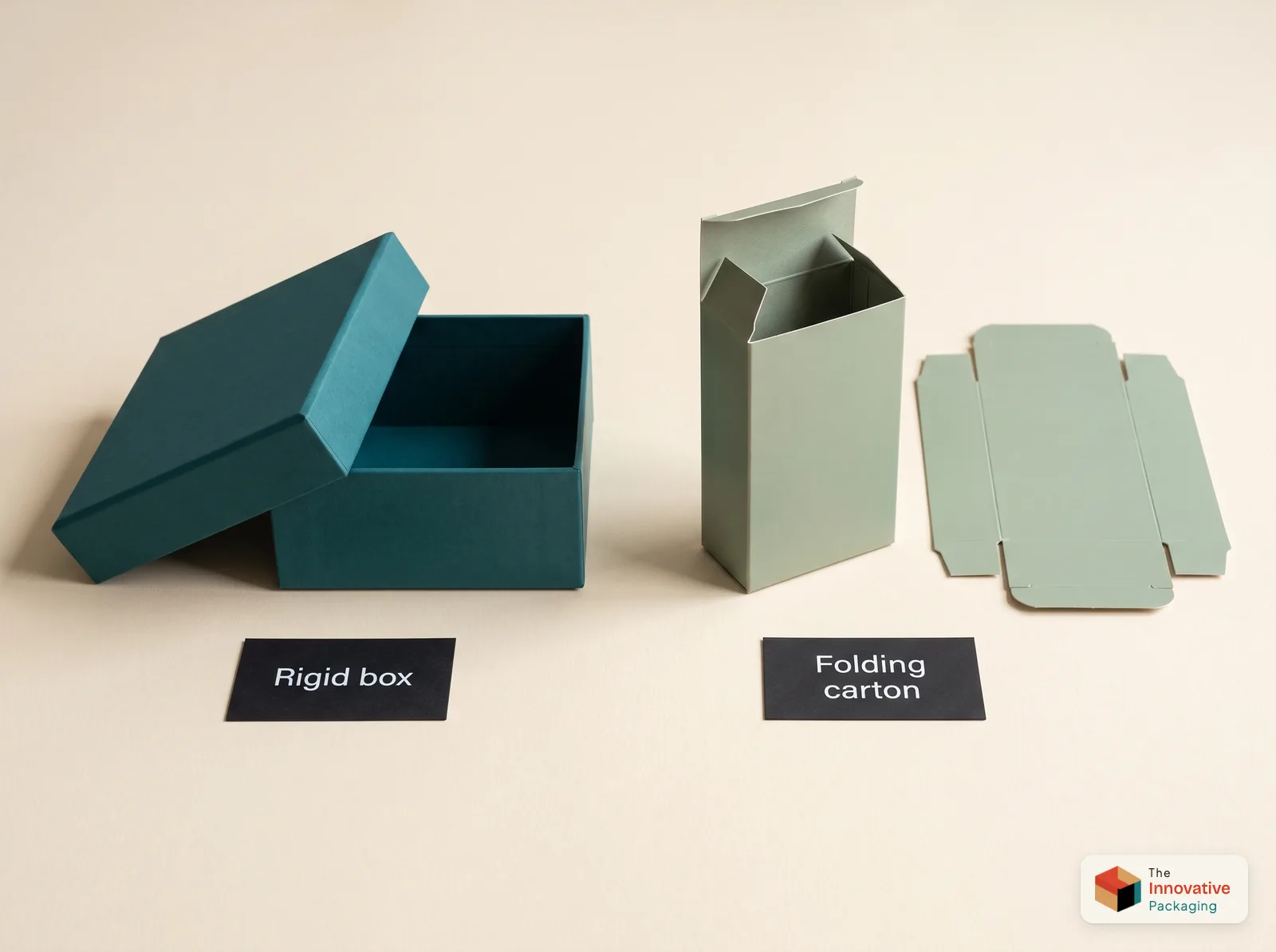
A rigid box, sometimes called a setup box, is built from thick chipboard (also called greyboard) between 1.5mm and 3mm. The board is cut, shaped into a box, and then wrapped in a separately printed paper. Because it is built in the factory, it does not fold flat. It arrives at your door ready to use.
That thick board is the whole point. When someone picks up a rigid box, it does not bend or give under their fingers. That solid feel is most of what makes it feel premium.
What is a folding carton?
A folding carton is the box most people picture when they think of product packaging. It is printed and cut from a single sheet of paperboard, then folded and glued. Paperboard thickness is measured in points (pt), and one point is 0.001 inch, or 0.0254mm (Lamitech). Cartons usually use 12pt to 24pt, which is about 0.3mm to 0.6mm. It ships flat, and you or your packing team fold it into shape.
Common examples are tuck end boxes, tray and sleeve boxes and two-piece boxes made from paperboard. Most cosmetic, supplement and food packaging on store shelves is a folding carton.
Rigid boxes vs folding cartons: the main differences
| Rigid box | Folding carton | |
|---|---|---|
| Board | 1.5mm to 3mm chipboard wrapped in printed paper | 12pt to 24pt paperboard (about 0.3mm to 0.6mm), printed directly |
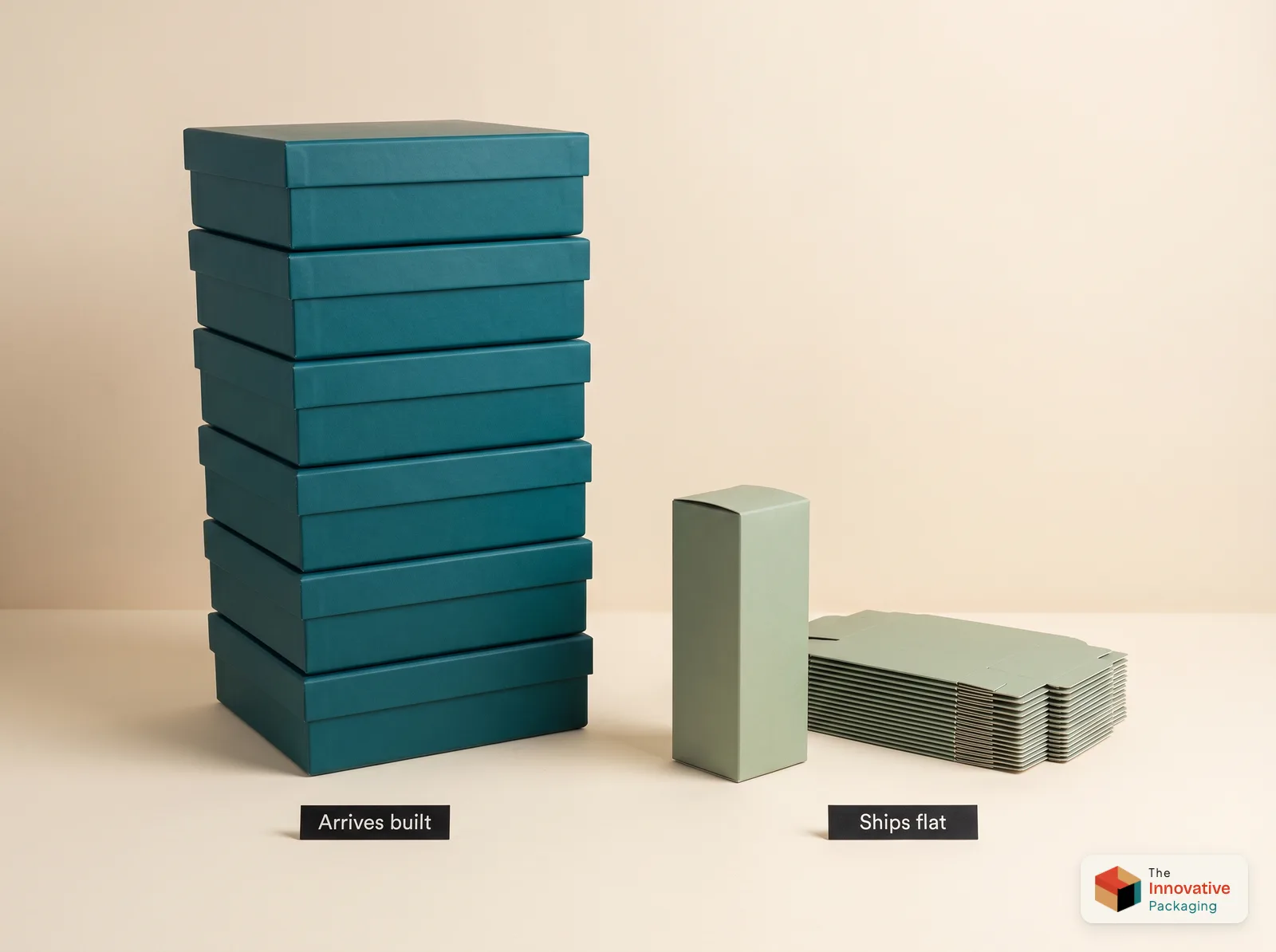
| How it arrives | Fully built, ready to use | Flat, folded by you |
| Feel in the hand | Heavy and solid, does not flex | Lighter, gives a little under pressure |
| Cost per box | Higher | Lower |
| Storage and freight | Takes much more space | Stacks flat, takes little space |
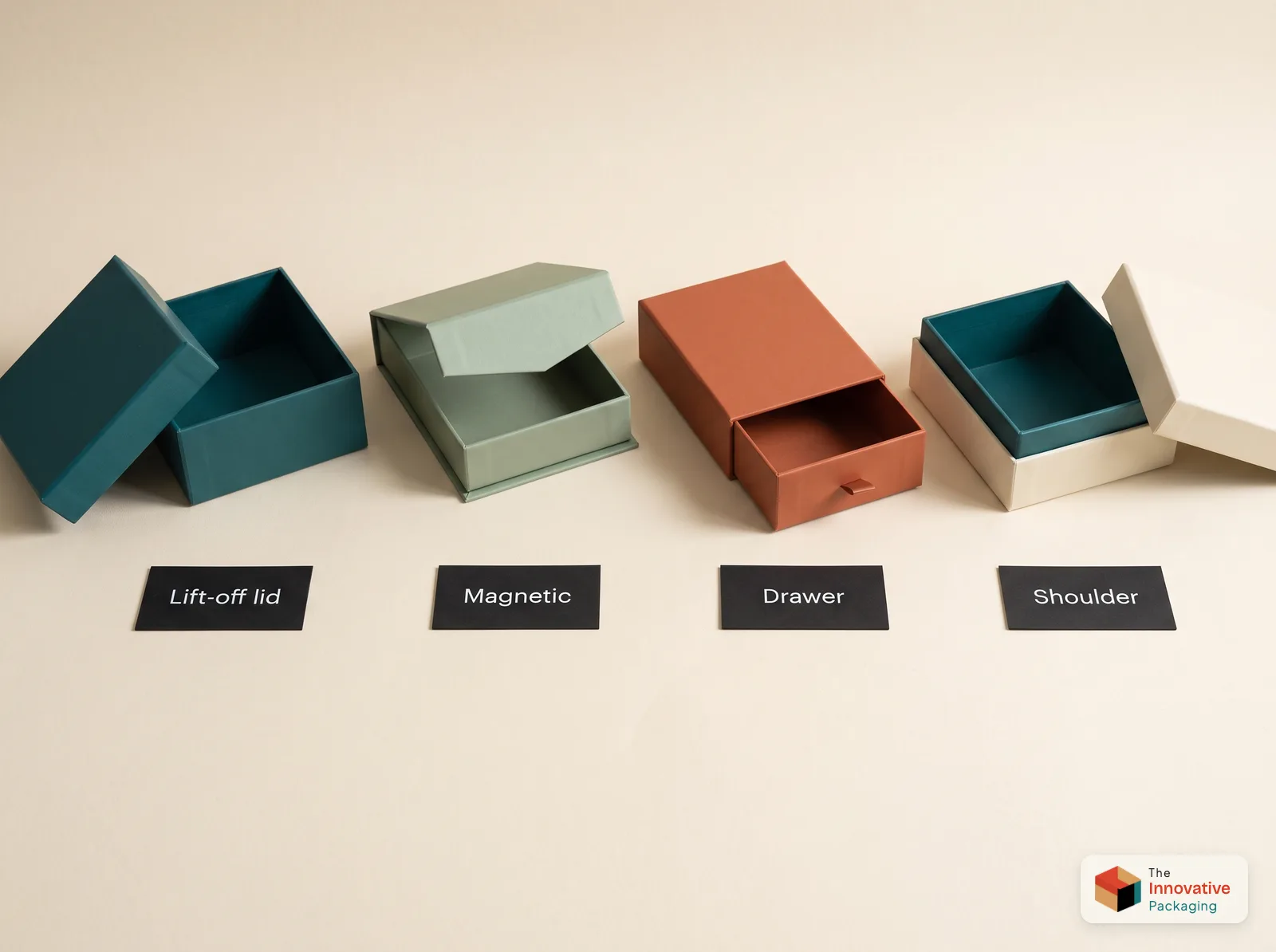
| Closures | Lift-off lid, magnetic, drawer, shoulder | Tuck flaps, auto-lock base, sleeve |
| Recycling | Usually not recyclable as is | Uncoated paper and kraft builds usually are |
| Best for | Gift sets, fragrance, jewelry, high-price items | Retail products, ranges with many sizes or flavors, larger runs |
A note on recycling: only call a box recyclable on its label if most of your customers can recycle it locally. That is the rule in the FTC Green Guides.
Why are rigid boxes considered premium?
Most luxury packaging is rigid for a reason. Three things set these boxes apart.
First, they do not flex. A box that gives slightly when you squeeze it feels cheap, no matter how well it is printed. A rigid box stays solid, and customers take that as a sign of quality before they even open it.
Second, they protect better. Thick board resists crushing and bending, so a rigid box is a good home for heavy or fragile items like glass bottles, candles and electronics.
Third, the lid opens smoothly. Because the walls are stiff, a lift-off or magnetic lid sits at the same gap every time and slides away smoothly instead of catching. That slow, clean reveal is a big part of a good unboxing.
What are the main types of rigid boxes?
- Lift-off lid: the classic two-piece rigid box, with a separate lid and base. Common for gifts, candles and jewelry.
- Magnetic closure: a book-style box with a hidden magnet that snaps shut. It feels the most premium and costs more per box.
- Drawer box: a tray that slides out of a printed outer sleeve. It opens slowly, which suits a deliberate reveal, and holds an insert well.
- Shoulder box: the lid closes onto a raised inner wall, called the shoulder, which stays visible when the box is shut. It is popular in fine fragrance.
Our perfume boxes page walks through each closure, since fragrance is where rigid board is most common. Our gift boxes also come in rigid board, with magnetic closures and ribbon pulls.
When is a rigid box worth the cost?
A rigid box earns its price when the box is part of what the customer is paying for. It is usually worth it if:
- Your product sells at a high price, and the box needs to match it
- The item is heavy or fragile, like a glass bottle with a metal cap
- It is a gift set, a launch edition or a corporate gift
- Customers keep the box after opening it
- Your buyers share unboxing photos and videos
A simple way to judge it: compare the box cost to what you charge for the product. If the box is a small share of the price, a rigid box is easy to justify. A common mistake is putting a low-price product in a rigid box, where the packaging ends up eating a big part of the margin.
Keep the other trade-offs in mind too. Rigid boxes cost more per unit, and because they arrive built, they take up a lot more room in your storage and in shipping. Our custom box cost guide explains how box style changes your price per box.
When is a folding carton the better choice?
For most products, a folding carton is the smarter buy. It makes sense when:
- You sell a lot of units, or many products in the same range
- You need to store or ship boxes in bulk
- Your product is light, like skincare, supplements or tea
- It is a travel size, a sample set or an entry-level product
- You want a box that is easier to recycle. 94% of Americans can recycle paper and paperboard in their community (AF&PA)
Folding cartons also have more structure options. You can browse them all in boxes by style.
Can a folding carton look as premium as a rigid box?
It can get close for a lot less money. Here is what helps the most:
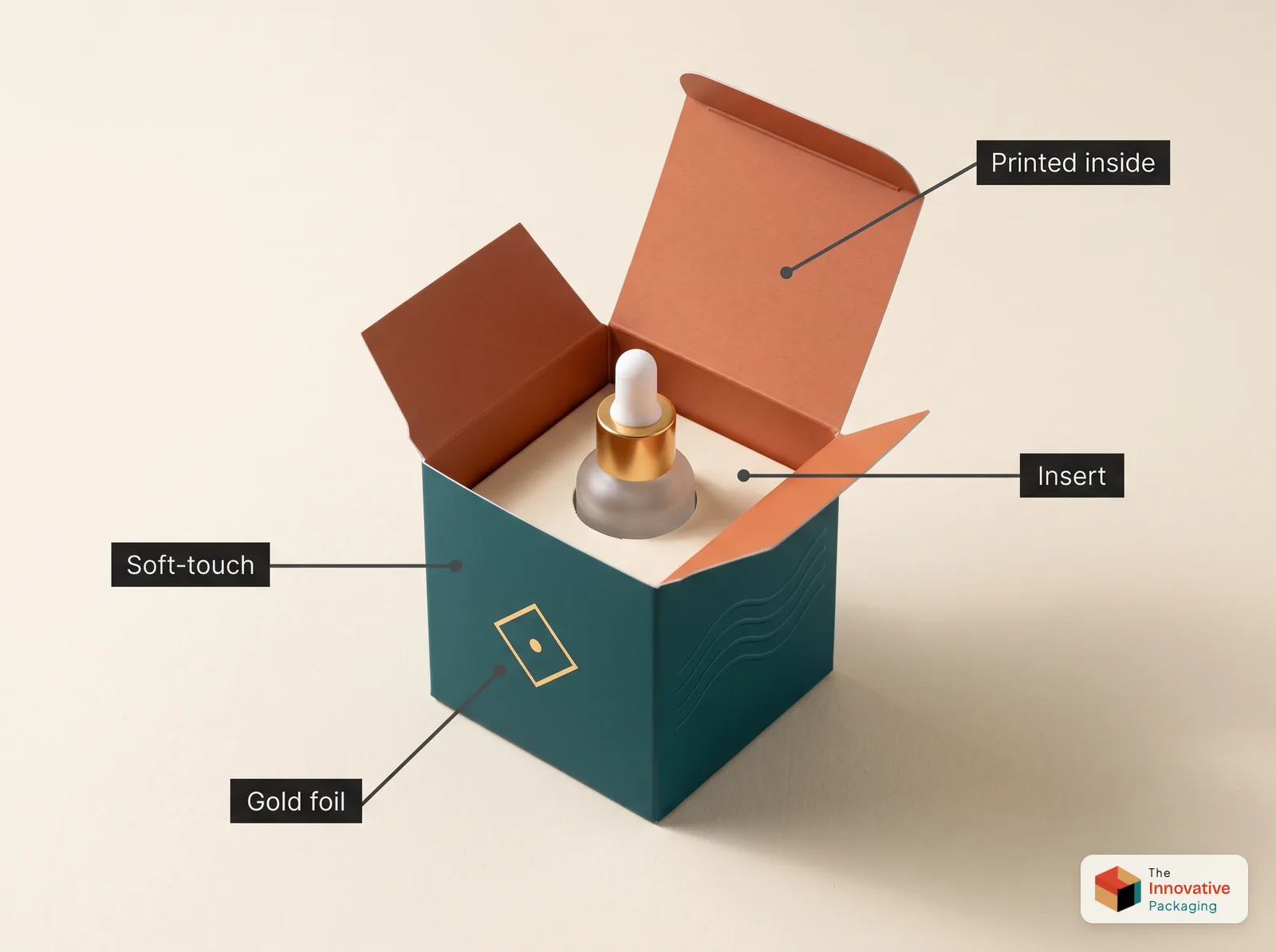
- Use heavier board. 18pt to 24pt feels much more solid than 12pt to 14pt, for a small extra cost.
- Choose soft-touch lamination. The velvety matte surface feels expensive in the hand.
- Use one standout finish, like gold foil on your logo or an embossed mark, instead of many.
- Print the inside of the box, so the opening feels designed.
- Add a fitted insert so the product sits neatly in place.
Our guide to matte vs gloss lamination helps you pick a finish, and our materials and printing page shows every board and finish we offer.
Which industries use rigid boxes?
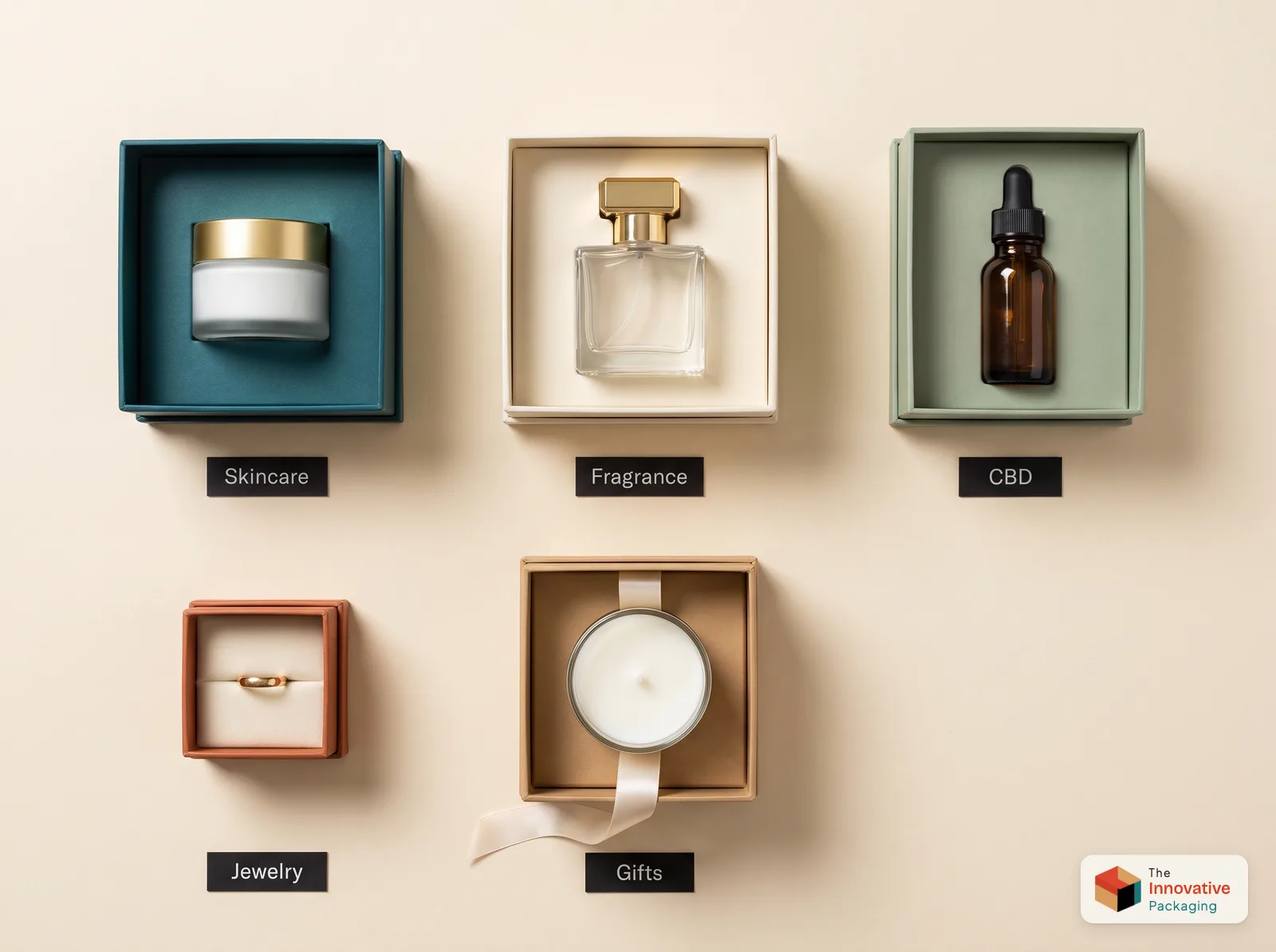
Rigid boxes show up wherever presentation matters as much as protection:
- Cosmetics and skincare: luxury sets and high-end creams. See our cosmetic boxes and our guide to choosing custom cosmetic boxes.
- Fragrance: perfume and cologne, where the box carries much of the buying decision.
- CBD: premium tinctures and gift sets. Our guide to choosing CBD packaging covers when rigid makes sense. Browse CBD boxes.
- Jewelry, watches and electronics: small, high-value items that need protection and a strong first impression.
- Gifts: holiday sets, gift collections and corporate gifts.
What should you ask before you order rigid boxes?
A few questions save a lot of trouble later:
- How thick is the board? Ask for the exact number in millimeters.
- Which closure fits your product and your budget?
- Do you need an insert to hold the product in place?
- Where will you store the boxes, since they arrive built?
- Which finishes add to the price, and by how much?
Every rigid box still starts as a flat design called a dieline. If the term is new, read what a dieline is and why it matters. And if you are still comparing suppliers, start with these 10 questions to ask a custom packaging supplier.
So which one should you choose?
Choose a rigid box when the packaging is part of the product: high-price items, gifts and anything customers will keep. Choose a folding carton for everyday retail products, large runs and lighter items, and use heavier board and one good finish to make it feel premium.
Not sure which fits? Send us your product, its size and your quantity, and we will tell you which build makes sense. Orders start at 100 units, every order includes a free dieline and a digital proof before printing, and shipping is free anywhere in the USA. Request a free quote for custom rigid boxes or folding cartons.
Founder & CEO, The Innovative Packaging · 10 years experience
Ijlal Ahmed founded The Innovative Packaging and runs its production facility in Pakistan. He is the third generation of his family in printing and packaging, a business they have been in for more than 50 years, and works directly with brands on quotes and dielines. He holds a BSc in Economics from the Lahore School of Economics.
Ijlal Ahmed on LinkedInFrequently Asked Questions
Shop the packaging in this guide
Custom Gift Boxes
Looking for premium custom gift boxes wholesale that make every unboxing memorable? At The Innovative Packaging, we craft custom gift packaging tailored to your brand, product dimensions, and presentation requirements. Whether you need packaging for corporate gifts, retail products, luxury items, or seasonal collections, we have a solution for every occasion.
Browse Custom Gift Boxes →Custom Cosmetic Boxes
Looking for premium custom cosmetic boxes wholesale that make your beauty brand stand out? At The Innovative Packaging, we produce fully custom cosmetic packaging tailored to your exact product dimensions, branding, and retail requirements. Whether you need boxes for perfume, serum, lip gloss, hair products, essential oils, or face care kits, we have a packaging solution for every product in your beauty lineup.
Browse Custom Cosmetic Boxes →Box by Style
We make custom packaging boxes in over 40 structural styles at The Innovative Packaging. Tuck end boxes, tray boxes, display boxes, specialty boxes, gift packaging. If there's a box style your product needs, we most likely make it. Every box ships fully custom printed to your exact dimensions and branding. Minimum order is 100 units per style, and design support is included at no extra cost.
Browse Box by Style →More from the blog
How Much Do Custom Boxes Cost in 2026? A Guide for Small Brands
Custom box prices depend on five things: style, size, material, print and finish, and quantity. Here is how each one moves the price, and how to get an exact quote.
Read more →10 Questions to Ask a Custom Packaging Supplier Before You Order
Before you pay a custom packaging supplier, ask ten things: what they make, the minimum order, design help, finishes, materials, lead time, proofs, sustainability, quality checks and support. Here is what a good answer sounds like.
Read more →Matte vs Gloss: Which Lamination is Better for Packaging?
Matte lamination gives a soft, premium feel. Gloss adds shine and vibrancy. Here is how to choose the right lamination finish for your custom packaging.
Read more →