Custom Candle Boxes
Candles are heavy, fragile, and usually made of glass - three properties that decide the box before any design work starts. A filled 8oz jar candle weighs around 400g concentrated in a small base, and that load goes straight through the bottom panel. The base structure, not the artwork, is what makes a candle box work.
FSC Certified
Sustainably sourced paper and board
Food-Grade Safe
FDA-compliant materials for direct food contact
Recyclable options available
Uncoated kraft and paper builds qualify; laminated, foil and rigid builds do not
Sedex Member
Audited for ethical, responsible sourcing
Specifications
- Material
- Cardboard / Kraft
- Printing
- Full-Color CMYK / Offset
- Finish
- Matte / Gloss Lamination
- MOQ
- 100 Units
Printing & Finishing
- Full-Color CMYK
- Spot Colors (Pantone)
- Interior Printing
The Base Is the Whole Problem
A standard tuck bottom is held closed by friction and a flap. Under a glass jar, dropped once into a shipping carton, it opens - and the candle goes through it. This is the most common packaging failure we are asked to fix in this category.
An auto-bottom, sometimes called a 1-2-3 bottom, is pre-glued so the base locks square as the box is opened and carries load across the whole panel rather than on a flap. It costs slightly more per unit and it is the correct choice for any glass jar candle. Above roughly 350g of filled weight, we would move to rigid or corrugated rather than a folding carton at all.
Jars, Tins and Pillars Are Different Builds
Glass jars are the heaviest and most fragile, and the lid usually makes the top wider than the body. Size to the widest point and the base can rock, so a snug fit at the base with clearance at the lid is the usual compromise. Our guide on shipping candles and glass jars safely covers inserts and summer heat.
Tins are light and forgiving, and their flat cylindrical shape suits a shallow tray-and-sleeve or a two-piece box better than a tall tuck end.
Pillars and tapers are the opposite problem: tall, unstable, and prone to scuffing against the board. They want a snug tube-style box or a partitioned tray, and they mark easily, so an uncoated interior is better than a heavily coated one.
Multi-wick and three-wick candles are wide and very heavy, and are the clearest case for a corrugated build - see our materials and printing page for how flute grades compare.
Windows, Wax and Scent
A die-cut window sells the colour and finish of the wax, which genuinely matters in a gifting category where the candle is chosen visually. Two trade-offs come with it. A window removes panel strength, so it should sit away from corners and folds, particularly on a box carrying 400g. And it exposes the wax to light, which can fade coloured wax over a long shelf life.
Scent is the less obvious issue. Fragrance oils migrate, and a candle stored in a box for months will transfer scent into the board. This is not a problem for a single candle, but for a mixed gift set it means two strong fragrances in one box will blend. Separate cells in a partitioned insert reduce it; individually wrapped candles inside the set solve it.
Seasonal Ranges on One Dieline
Candle sales are concentrated into autumn and winter, and most brands run a seasonal collection alongside a core range. The efficient way to handle that is one dieline with several artworks: the vessel does not change between scents, so the box structure does not need to either, and a new seasonal design becomes a print run rather than a new tooling job.
Since there are no die or plate charges, each seasonal artwork costs unit price only, at the same 100-unit minimum. That is what makes small limited editions viable in this category, where a brand might want 150 units of a Christmas design and 2,000 of the core one.
Candle Box Sizes We Build
- 4oz jar: around 70 x 70 x 85mm.
- 8oz jar: around 85 x 85 x 100mm, auto-bottom as standard.
- Three-wick jar: around 115 x 115 x 110mm, usually corrugated.
- Travel tin: around 80 x 80 x 45mm as a shallow two-piece.
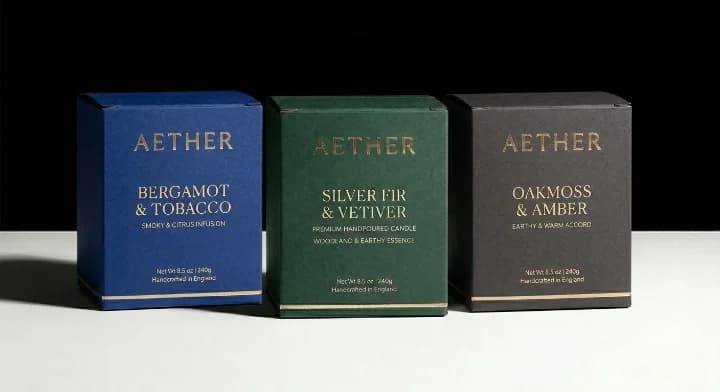
- Three-candle gift set: around 250 x 90 x 100mm with a partition.
All internal dimensions, and all cut to your vessel rather than to this list.
Safety Copy and the Base Panel
Candles carry fire-safety guidance - keep away from drafts and flammables, never leave burning unattended, trim the wick, stop use at a minimum wax depth. Most of that belongs on the vessel itself, since the box is thrown away and the candle is not, but retailers frequently want it on the carton too.
The base panel is where it goes. It is the one panel with no branding job to do, it is legible when the box is picked up, and it keeps the warning block away from the front-of-pack design. Burn time, wax type, fragrance notes and net weight sit naturally alongside it. If your candles are sold into retailers with their own labelling requirements, confirm those before the dieline is drawn - warning copy that arrives late is the usual reason a candle box has to be reprinted.
Retail Box or Shipping Box
These are two different boxes and conflating them is expensive. A printed folding carton is a retail box: it is designed to look good on a shelf and to be carried home, not to survive a courier network. Glass in a single-wall carton handed to a carrier will arrive broken often enough to hurt.
If you ship direct to consumers, the standard setup is the retail box inside a corrugated mailer with void fill. If you would rather ship in one box, the retail box itself has to be corrugated, which changes the print surface and the design. Deciding which model you are in before the dieline is drawn saves a rebuild.
Ordering
The number we need most is the filled weight. Send that alongside the vessel dimensions with the lid on, and say whether the box goes to a retailer or to a customer's door. The base structure follows from those two answers, and we will not spec a tuck bottom under glass. Related: soap boxes and the gift packaging range.
Custom Candle Boxes — FAQs
Got questions? We have answers. If you need anything else, get in touch.
Weight is the deciding factor. A glass jar candle needs an auto-bottom or a 1-2-3 bottom so the base locks under load - a standard tuck bottom can pop open. For jars over about 350g, rigid or corrugated is the safer choice.
A die-cut window sells the colour and finish of the wax, which matters for gifting. The trade-off is that it exposes the candle to light and removes some panel strength, so keep the cut-out away from the corners and folds.
Only in corrugated. A printed folding carton is a retail box, not a mailer - glass in a single-wall carton will not survive courier handling. If you ship direct to consumer, a corrugated mailer around the retail box is the standard setup.
Related Products
Ready to start your project?
Tell us what you need. We get back to you within a business day.