How Much Should You Spend on Packaging? A Budget Guide for Small Brands
There is no single right amount to spend on packaging, and no reliable industry percentage to copy. The right budget comes from your own numbers: what you charge, what the product costs you and the profit margin you want to keep. Work out how much room your margin leaves for packaging, then spend it where customers notice most, starting with fit and protection and ending with finishes.
You will find plenty of "typical" packaging percentages online, but they come mostly from packaging suppliers, and they range from a few percent of a product's price to well over a third. A candle, a phone case and a luxury gift set simply have very little in common. Here is how a small business can set a packaging budget that fits its product instead, with a worked example built on published figures.
What percentage of the price should packaging be?
There is no reliable standard percentage. How much a brand should spend on packaging depends on three things:
- The price of the product. A $90 serum can carry a much richer box than a $9 soap.
- The role the box plays. For a gift, the box is part of what the customer is buying. For a refill pack, it barely matters.
- How the product travels. A fragile product shipped across the country needs more protection than one sold over a counter.
Margins vary just as widely by industry. In January 2026, the average gross margin for US public companies was about 51 percent in household products, 57 percent in apparel and 23 percent in food processing (NYU Stern, Damodaran). A food brand and a skincare brand will never have the same amount left over for the box. So instead of copying another brand's percentage, start from your own margin.
How to set a small business packaging budget in four steps
- Know your price and costs. Write down your selling price, the cost of the product itself and every other cost per order, such as payment fees and fulfillment.
- Choose your target gross margin. Decide what share of the price you need to keep. Industry averages like the ones above are a useful reference point, but your own costs and goals come first.
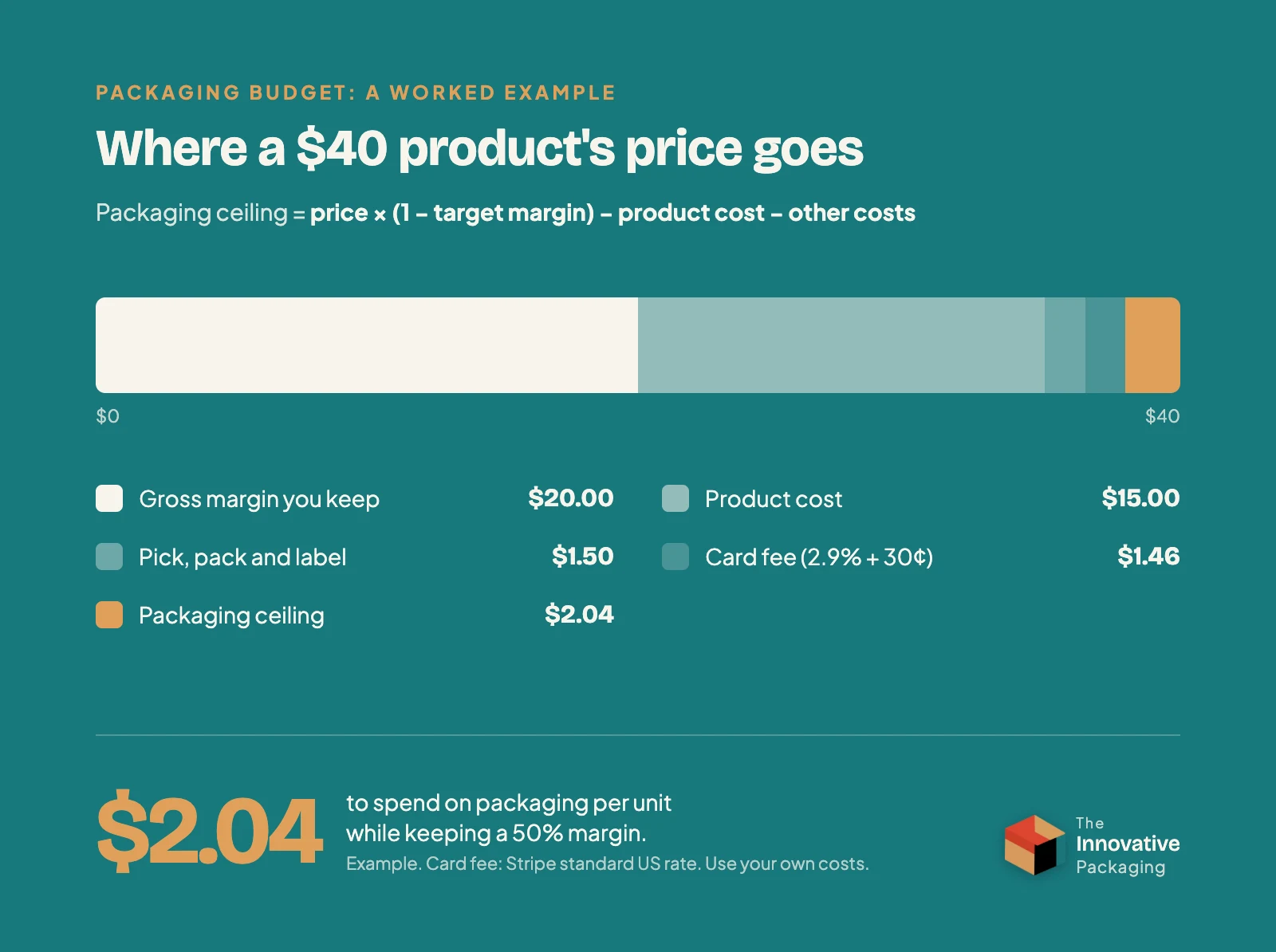
- Find your packaging ceiling. Packaging ceiling per unit = price × (1 − target margin) − product cost − other costs per unit.
- Spend it in order of impact. Use the priority list below, and stop when you reach the ceiling.
A worked example
Take a small skincare brand selling a $40 product online. We set the target margin at 50 percent, close to the household products average above. The payment fee uses Stripe's standard US rate of 2.9 percent plus 30 cents per card transaction (Stripe). The product and fulfillment costs are examples, so replace them with your own.
| Item | Per unit | Where the number comes from |
|---|---|---|
| Selling price | $40.00 | Your price |
| Allowable costs at a 50 percent margin | $20.00 | $40.00 × (1 − 0.50) |
| Product cost | $15.00 | Example, use your own |
| Card payment fee | $1.46 | 2.9% of $40 plus $0.30 |
| Pick, pack and label | $1.50 | Example, use your own |
| Packaging ceiling | $2.04 | $20.00 − $15.00 − $1.46 − $1.50 |
With about $2 a unit to work with, this brand can afford a custom printed carton with one standout finish. It probably cannot afford a rigid box, and that is fine. The point is to know the limit before you start choosing upgrades, so you never end up with a beautiful box that quietly eats your profit.
Unit prices fall as order quantities rise, so the same ceiling buys more at higher volumes. Our guide to how much custom packaging costs explains what moves the price of each box.
How much to spend by product price
Once you know your ceiling, the product's price point tells you where the money does the most good.
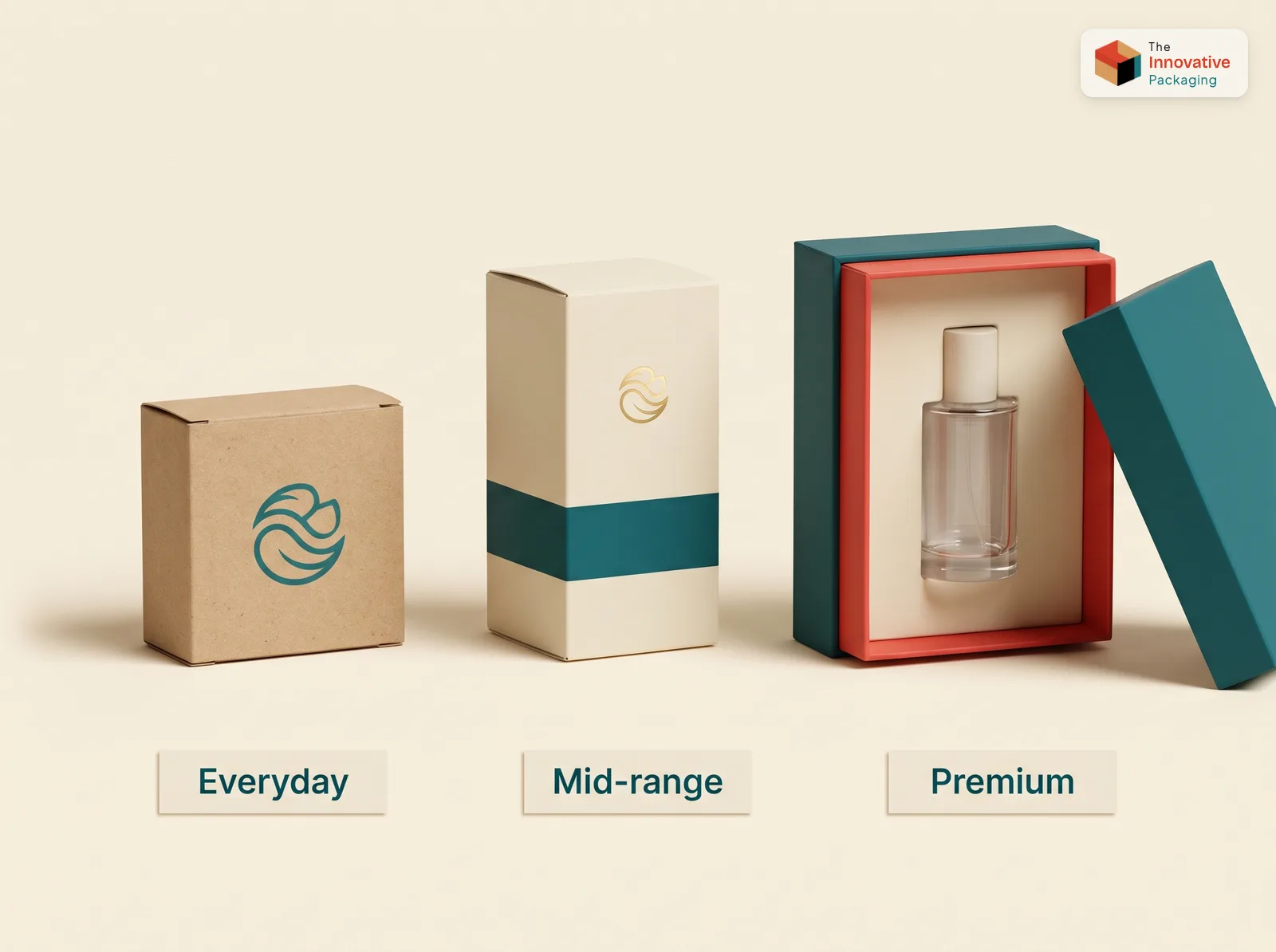
Everyday products
For lower-priced products such as soaps, snacks and accessories, keep the box simple and efficient. A well-fitted folding carton with a clean, one- or two-color design looks professional without eating into thin margins. Spend on fit and readable design, not on special finishes. Simple tuck end retail packaging boxes fit this tier well, and bath and body brands can keep costs down with custom bath bomb boxes cut closely to the product. Food brands can do the same with simple dates packaging boxes and similar cartons.
Mid-range products
For products in the middle of the market, such as skincare, candles and supplements, packaging starts to shape how customers judge value. This is where a custom printed box, heavier board and one well-chosen finish, such as a foil or embossed logo, earn their keep. Typical examples include serum boxes and CBD boxes wholesale runs for growing dispensary brands.
Premium and gift products
For high-priced products and gifts, premium packaging is part of the experience the customer is paying for. A rigid box or a heavy folding carton, soft-touch lamination, a fitted insert and a printed interior all help justify the price. Here, spending too little is the bigger risk. If a rigid box is beyond your ceiling, custom six corner gift boxes in heavy paperboard ship flat and still give a gift-worthy reveal.
Where to spend first
If your budget is tight, spend in this order. Each step builds on the one before it.
- Fit and protection. A box sized to the product, with an insert if it is fragile. A damaged product wastes every other dollar you spent.
- Board strength. Customers judge quality by weight. In one study, heavier packaging raised both how much people wanted a product and what they said they would pay for it (PLOS ONE).
- A clear front panel. Good design costs the same to print as bad design. Our packaging design checklist helps you get it right.
- One standout finish. Foil, embossing or spot UV on your logo, not all three.
- The unboxing. A printed interior, a thank-you card or a fitted insert that presents the product neatly. Our guide to ecommerce packaging covers this step in detail.
Where to save without looking cheap
- Right-size every box. Carriers charge bulky parcels by size as well as weight. In July 2026, USPS moved its dimensional weight divisor from 166 to 139 for packages over one cubic foot, bringing it in line with FedEx and with UPS daily rates (Supply Chain Dive). A lower divisor means oversized boxes cost more to ship, so a snug custom box can save money on every order.
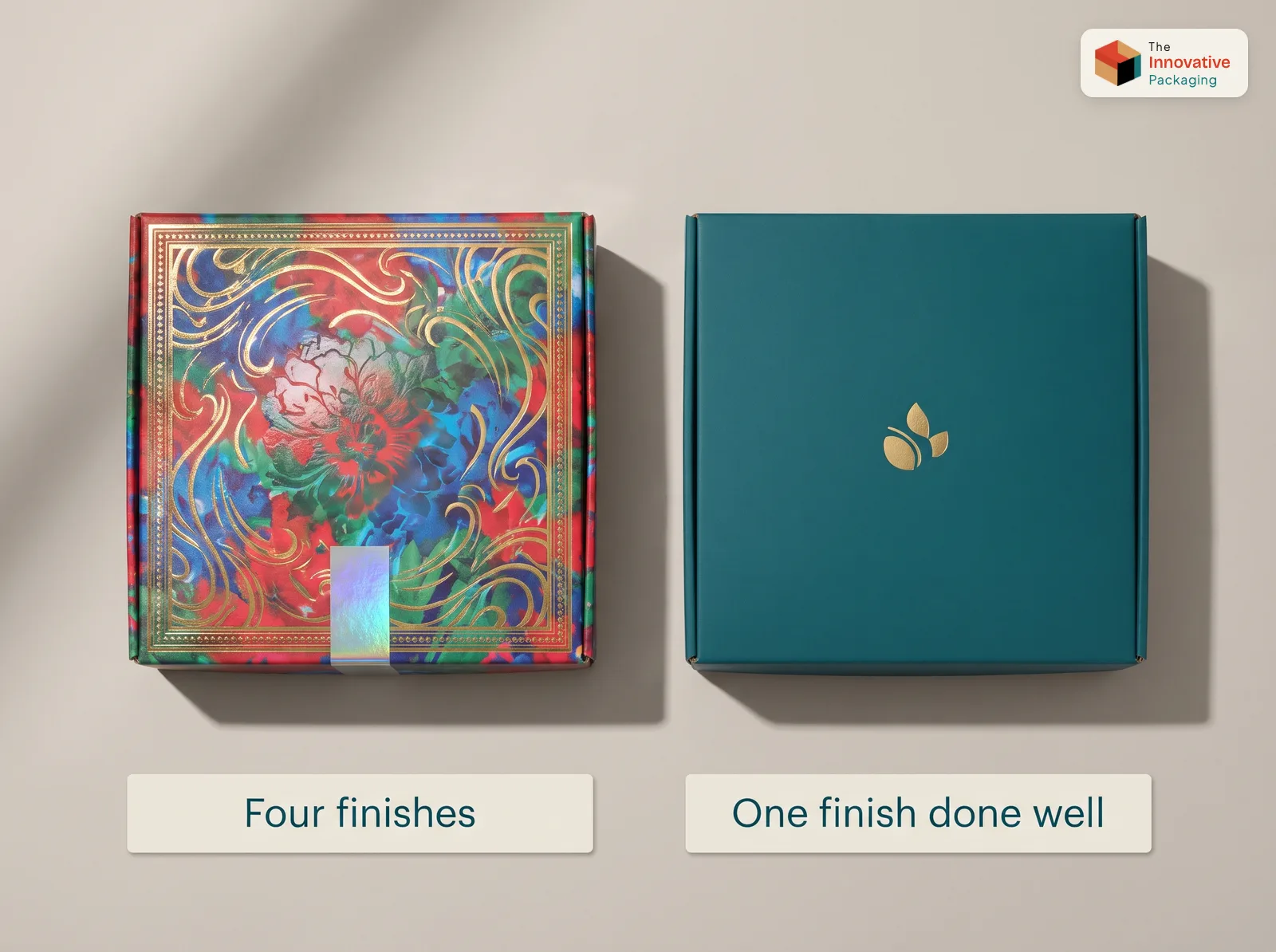
- Cut finishes, not board. One finish done well looks more expensive than four competing ones, and thin board is the first thing customers notice.
- Keep the inside to one color. With us, a one-color print inside the box is free on every order, while full color inside is an upgrade. One bold inside color delivers most of the surprise.
- Simplify the structure. Tuck end boxes cost less than complex shapes and still look sharp when well printed. Only step up to pre-glued auto bottom boxes when the product is heavy enough to need a locking base.
- Use one design across your range. A shared layout with one accent color per variant keeps design simple and consistent.
- Order sensible quantities. Bigger runs lower the unit price, but only if you will use the boxes before your design changes.
For more ideas on making a modest budget look generous, see our guide on how to make packaging look expensive.
The hidden cost of spending too little
The cheapest box is not always the cheapest choice. A box that is too thin or too big leads to breakages, replacement shipments and returns, and those costs never show up on the packaging invoice. Returns are already a heavy burden: US shoppers were expected to send back about 15.8 percent of retail purchases in 2025 (National Retail Federation). A box that looks cheaper than the product can also drag down the price customers are willing to pay. And a forgettable delivery gives them little reason to come back. In a 2024 Ryder survey of 1,306 US online shoppers, 41 percent said a premium unboxing made them want to buy from the brand again (Packaging Technology Today).
That is why your packaging budget should be judged on what it saves and earns, not only on what it costs. Our guide on whether custom packaging is worth it shows how to measure the return, and our guide on how to prevent shipping damage covers the protection side.
Spend with intent, not guesswork
The brands with the best packaging rarely spend the most. They know their ceiling, put the money where customers can see and feel it, and leave out everything else. Set your budget from your own margin, spend it in order of impact, and review it whenever your price, costs or volume change.
Want help making your budget go further? Tell us your product, your target price per box and your quantity, and we will recommend the structure, board and finish that fit. Orders start at 100 units, volume pricing starts at 500, every order includes a free dieline and a digital proof before printing, and shipping is free anywhere in the USA. Request a free custom packaging quote.
Founder & CEO, The Innovative Packaging · 10 years experience
Ijlal Ahmed founded The Innovative Packaging and runs its production facility in Pakistan. He is the third generation of his family in printing and packaging, a business they have been in for more than 50 years, and works directly with brands on quotes and dielines. He holds a BSc in Economics from the Lahore School of Economics.
Ijlal Ahmed on LinkedInFrequently Asked Questions
Shop the packaging in this guide
Custom Retail Boxes
Looking for high-quality custom retail packaging boxes wholesale that help your products stand out on shelves? At The Innovative Packaging, we produce fully custom retail boxes tailored to your brand identity, product dimensions, and retail environment. Whether you need packaging for cosmetics, food, paper bags, mailer boxes, or display packaging, we have a solution for every retail product in your lineup.
Browse Custom Retail Boxes →CBD Boxes
Looking for high-quality custom CBD boxes wholesale that make your brand stand out? At The Innovative Packaging, we specialize in crafting premium CBD packaging boxes tailored to your exact product dimensions, branding, and compliance requirements. Whether you need packaging for CBD oils, tinctures, capsules, creams, soaps, or gummies, we have a solution for every product in your lineup.
Browse CBD Boxes →Custom Display Boxes
Looking for high-quality custom display boxes wholesale that maximize your product visibility at retail? At The Innovative Packaging, we produce fully custom display packaging tailored to your product dimensions, brand identity, and retail environment. Whether you need counter display boxes, floor display units, or shelf-ready display packaging, we have a solution for every product and retail setting.
Browse Custom Display Boxes →More from the blog
How Much Do Custom Boxes Cost in 2026? A Guide for Small Brands
Custom box prices depend on five things: style, size, material, print and finish, and quantity. Here is how each one moves the price, and how to get an exact quote.
Read more →Is Custom Packaging Worth It? How to Measure Packaging ROI
Is custom packaging worth it? For most brands, yes. Here is where the return really comes from, a simple formula for packaging ROI and a worked example you can copy with your own numbers.
Read more →8 Ways to Make Your Packaging Look Expensive on Any Budget
The most expensive-looking packaging is rarely the most expensive to make. Here is how to make packaging look premium on a small budget: a calmer design, heavier board, soft-touch lamination, one well-chosen finish and an unboxing worth remembering.
Read more →