Is Custom Packaging Worth It? How to Measure Packaging ROI
Yes, custom packaging is worth it for most brands, as long as it earns back more than it costs. It pays you back in five ways: fewer damaged orders, lower shipping costs, a higher price customers will accept, more repeat purchases and free marketing every time a box is opened or shared. The only way to know whether yours is paying off is to measure it, and the math is simpler than most brands think.
Most companies judge packaging by one number: the unit price on the invoice. That number matters, but it tells only half the story. Here is how to look at the other half, with a simple formula and a worked example you can copy.
What is packaging ROI?
Packaging ROI, or return on investment, compares what better packaging costs with what it gives back. The formula is the same one you would use for any marketing spend:
Packaging ROI = (gains + savings − extra packaging cost) ÷ extra packaging cost
"Extra packaging cost" is the difference between the packaging you have now, or a plain stock box, and the packaging you are considering. "Gains and savings" are the money that difference brings in or keeps from going out. If the result is above zero, the packaging is paying for itself. If it is above 100 percent, every dollar you put in is coming back more than twice.
Where the return comes from
Most of the value of packaging never shows up on the packaging invoice. It shows up in other parts of the business, which is exactly why it is so easy to miss.
1. Fewer damaged orders and returns
Returns are expensive, and they are everywhere. US shoppers were expected to send back nearly $850 billion in merchandise in 2025, about 15.8 percent of retail sales and 19.3 percent of online sales (National Retail Federation). Packaging cannot stop every return, but it can stop the ones caused by breakage. Each damaged order costs you the product, a second shipment, time with customer service and, often, a review you would rather not read. Our guide on how to prevent shipping damage shows where those losses start.
2. Lower shipping costs
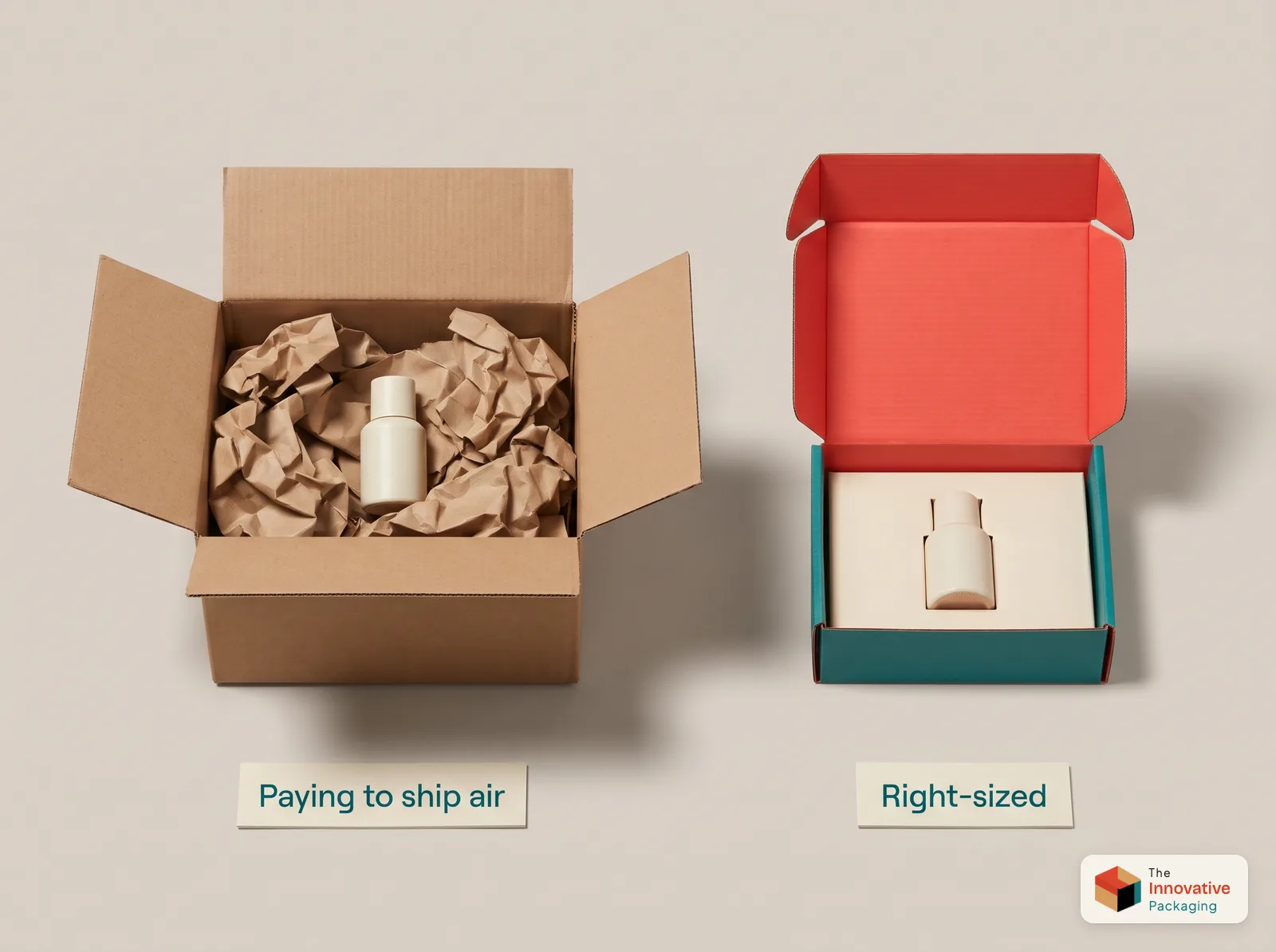
Major carriers such as UPS and FedEx charge by size as well as weight, using what is called dimensional weight. A box that is bigger than it needs to be can cost more to ship than the product inside it weighs. Custom packaging is sized to your product, so you stop paying to ship air, and the saving repeats on every single order.
3. A price customers will accept
Two nearly identical products can sell at very different prices, and the difference is often the presentation. Heavier board, a clean design and one well-chosen finish make a product look worth more before anyone tries it. If good packaging lets you charge even a dollar or two more, that margin usually covers the extra cost of the box many times over. Our guide on how to make packaging look expensive shows which upgrades do the most for the least.
4. More repeat purchases
Winning a second order is far cheaper than winning a new customer, and packaging plays a part. In a 2024 survey of 1,306 US online shoppers by logistics company Ryder, 41 percent said a premium unboxing experience made them want to buy from the brand again (Packaging Technology Today). Our guide to ecommerce packaging covers how to build that kind of unboxing.
5. Free marketing
Every box you ship is seen by the customer, and often by the people around them. A branded mailer on a doorstep, a striking box on a shelf or an unboxing shared online all reach new people at no extra cost. Unlike an ad, you pay for that exposure once, when you print the box, and it keeps working on every order.
How to calculate packaging ROI: a worked example
Here is a simple example for a small online brand. The numbers are illustrative, so swap in your own.
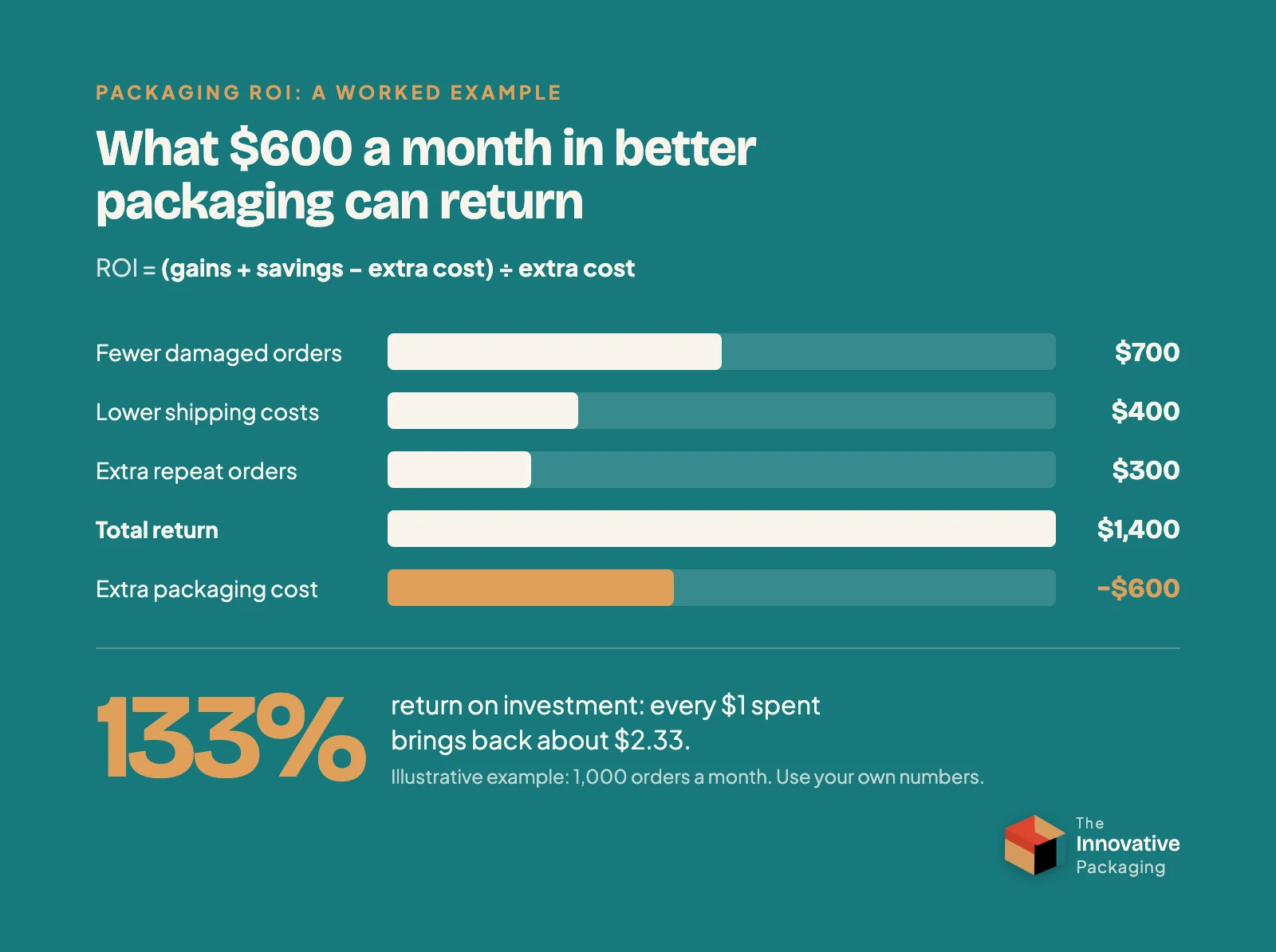
The brand ships 1,000 orders a month in a plain stock box. It is considering a custom printed mailer with a fitted insert that costs $0.60 more per order, or $600 a month.
| What changes | Before | After | Monthly value |
|---|---|---|---|
| Damaged orders (replacement cost $35 each) | 3 percent, 30 orders | 1 percent, 10 orders | $700 saved |
| Shipping cost from a right-sized box | Oversized stock box | $0.40 less per order | $400 saved |
| Repeat orders ($15 profit each) | Baseline | 20 extra orders | $300 gained |
| Total return | $1,400 |
Now plug it into the formula: ($1,400 − $600) ÷ $600 = 1.33, or a 133 percent return. In plain terms, every dollar spent on better packaging brings back about $2.33. That is before counting any price increase or the marketing value of the box itself, which are harder to measure but just as real.
Your numbers will differ. A brand with fragile, expensive products will gain most from fewer breakages. A brand with light products in big boxes will gain most on shipping. The point is to put real numbers on both sides, rather than looking at the cost side alone.
What most brands get wrong about packaging ROI
- Measuring only the unit price. The cheapest box often costs the most once you add breakage, oversized shipping and lost repeat orders.
- Ignoring the cost of poor packaging. Damaged orders and returns rarely get traced back to the box, so the box never gets the blame, or the credit.
- Overspending on finishes. Five special effects rarely earn more than one. Spend first on fit, board strength and a clean design, then add a single standout finish.
- Treating each box on its own. Customers experience your mailer, product box, insert and card as one thing. A consistent set builds more trust than one fancy box among plain ones.
- Never measuring. If you do not track damage rates, shipping costs and repeat orders before and after a change, you cannot know what the change was worth.
When custom packaging may not be worth it yet
Custom packaging is not the right first step for everyone. If you are still testing whether a product will sell, ship small batches in stock boxes and save custom printing for the products that prove themselves. The same applies if your margins are so thin that even a modest packaging upgrade would wipe them out. In those cases, start with the free improvements, such as a better-fitting stock box or a printed thank-you card, and upgrade once the numbers support it.
For most growing brands, though, the question is not whether they can afford custom packaging. It is how much poor packaging is already costing them.
How to get a better return from your packaging
- Right-size first. A box that fits the product protects it better and costs less to ship.
- Protect what breaks. A simple insert usually pays for itself in avoided replacements.
- Spend on what customers notice. Board strength, a printed interior and one finish on your logo beat extra decoration.
- Order the right quantity. Unit prices fall as quantities rise, so order in sensible runs once a design is proven.
- Track three numbers. Damage rate, shipping cost per order and repeat purchase rate. Check them before and after any packaging change.
For a closer look at what drives the price of a box, see our breakdown of how much custom packaging costs. When you compare quotes, our list of questions to ask a custom packaging supplier helps you compare like with like.
The real return is not measured in boxes
The most profitable packaging is rarely the cheapest. It is the packaging that arrives intact, ships efficiently, supports your price and brings customers back for a second order. Measure it the way you would measure any other investment, and it usually earns its place.
Want to know what better packaging could return for your brand? Tell us about your product, your monthly volume and how you ship, and we will recommend a box that fits your goals and budget. Orders start at 100 units, every order includes a free dieline and a digital proof before printing, and shipping is free anywhere in the USA. Request a free custom packaging quote.
Founder & CEO, The Innovative Packaging · 10 years experience
Ijlal Ahmed founded The Innovative Packaging and runs its production facility in Pakistan. He is the third generation of his family in printing and packaging, a business they have been in for more than 50 years, and works directly with brands on quotes and dielines. He holds a BSc in Economics from the Lahore School of Economics.
Ijlal Ahmed on LinkedInFrequently Asked Questions
Shop the packaging in this guide
Box by Style
We make custom packaging boxes in over 40 structural styles at The Innovative Packaging. Tuck end boxes, tray boxes, display boxes, specialty boxes, gift packaging. If there's a box style your product needs, we most likely make it. Every box ships fully custom printed to your exact dimensions and branding. Minimum order is 100 units per style, and design support is included at no extra cost.
Browse Box by Style →Eco-Friendly Packaging Boxes
Looking for sustainable custom eco-friendly packaging boxes wholesale that reflect your brand's commitment to the environment? At The Innovative Packaging, we produce fully custom green packaging using kraft paper, recycled cardboard, and biodegradable materials tailored to your exact product dimensions and branding. Whether you need eco-friendly boxes for food, dates, baked goods, or general retail products, we have a sustainable packaging solution for every product in your lineup.
Browse Eco-Friendly Packaging Boxes →Custom Retail Boxes
Looking for high-quality custom retail packaging boxes wholesale that help your products stand out on shelves? At The Innovative Packaging, we produce fully custom retail boxes tailored to your brand identity, product dimensions, and retail environment. Whether you need packaging for cosmetics, food, paper bags, mailer boxes, or display packaging, we have a solution for every retail product in your lineup.
Browse Custom Retail Boxes →More from the blog
How Much Do Custom Boxes Cost in 2026? A Guide for Small Brands
Custom box prices depend on five things: style, size, material, print and finish, and quantity. Here is how each one moves the price, and how to get an exact quote.
Read more →How to Prevent Shipping Damage and Reduce Returns With Better Packaging
A cracked bottle or a crushed corner turns a sale into a refund and a bad review. Here is how to prevent shipping damage and reduce returns with the right box size, custom inserts, stronger corrugated board, clear labels and a simple drop test.
Read more →Your Box Is Your Storefront: Ecommerce Packaging That Sells
For online brands, the shipping box is the storefront. Here is how to build ecommerce packaging that protects every order, creates an unboxing experience worth sharing and brings customers back, even on a small budget.
Read more →