Custom Chocolate Boxes
Chocolate packaging is presentation engineering. The product is small, uniform, and easily marked, and its value is almost entirely in how it is arranged when the lid comes off. A box that holds twelve truffles in a grid reads as a gift; the same twelve loose in a carton read as stock. The insert is the product experience.
FSC Certified
Sustainably sourced paper and board
Food-Grade Safe
FDA-compliant materials for direct food contact
Recyclable options available
Uncoated kraft and paper builds qualify; laminated, foil and rigid builds do not
Sedex Member
Audited for ethical, responsible sourcing
Specifications
- Material
- Cardboard / Kraft (Food-Safe)
- Printing
- Full-Color CMYK / Offset
- Finish
- Matte / Gloss Lamination
- MOQ
- 100 Units
Printing & Finishing
- Full-Color CMYK
- Spot Colors (Pantone)
- Interior Printing
Three Different Products Under One Name
Bars are flat, rigid and usually already wrapped in foil or flow wrap, so the outer box is a branding surface rather than a protective one. A sleeve over a wrapped bar is the most material-efficient build in confectionery and the most common at retail. A full carton gives more print area and a better gifting feel.
Assortments and truffles are the structural challenge: round, soft-surfaced, easily scuffed, and sold on their arrangement. These need a cavity insert and usually a two-piece box.
Bark, clusters and irregular pieces sit between the two - they cannot be seated in a grid, so they want a bag or a tray inside a carton, with the box doing the presentation and the inner holding the pieces.
Insert Formats and Cavity Counts
The insert decides how the box opens, so choose it early. A punch partition in paperboard is the most economical and gives a clean grid. A moulded tray holds shaped pieces precisely and suits an assortment where each piece is different. A fence partition divides a box into rows and works for bars, bark, or bagged pieces.
Common counts are 4, 6, 9, 12, 16 and 24, and the count drives the box footprint more than the piece size does. Note that an insert is not only presentation: it stops pieces sliding into each other, which is the main cause of scuffed chocolate arriving looking second-hand.
Boxes We Build For Confectionery
- Single bar sleeve: around 165 x 80 x 12mm.
- Single bar carton: around 170 x 85 x 15mm.
- Four-piece truffle box: around 110 x 110 x 35mm.
- Nine-piece assortment: around 165 x 165 x 40mm with a punch partition.
- Twenty-four-piece gift box: around 320 x 220 x 45mm, two-piece with a moulded tray.
Internal dimensions, built to your pieces rather than to a stock cavity size.
Windows and the Case for Not Having One
A window sells an assortment on sight, which is why so much boxed chocolate has one. Two things to weigh. Backing film adds a material that has to be separated for recycling, and PET is the better choice over other films for that reason. And light plus warmth accelerates the surface changes chocolate is prone to, so a window on a box that sits in a bright retail display is working against the product.
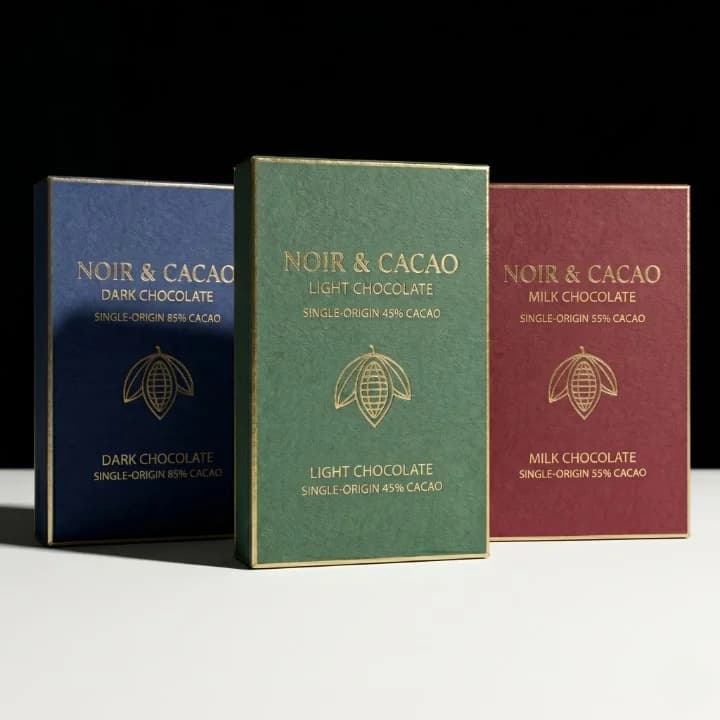
The alternative most premium brands choose is a solid lid with foil or embossing, and the reveal saved for the moment of opening. It also lets you use the whole lid as a design surface, which a window necessarily interrupts.
Seasonal Runs and Short Editions
Confectionery is more seasonal than almost any other category - Valentine's, Easter, Christmas and corporate gifting can account for most of a year's volume, and each wants its own artwork.
Because we charge no die, plate, or setup fees, a seasonal edition costs unit price only. One dieline can carry an unlimited number of artworks, so a brand can run 200 units of a Valentine's design and 3,000 of the core box from the same structure. That is what makes small limited editions and corporate-branded runs viable at a 100-unit minimum, which in this category is usually the difference between offering personalisation and not.
Corporate Gifting and White Label
A large share of chocolate volume is bought by someone who is not going to eat it - corporate gifts, wedding favours, hotel amenities, event giveaways. That work has different requirements from retail: small quantities, a client's branding rather than yours, and a deadline that does not move.
The structure that suits it is a plain two-piece box with a printed sleeve or a belly band. The box is produced once in volume, and each client's branding lives on the sleeve, which is cheap to print in small runs. That way a 150-unit corporate order does not need its own box production at all - only a new sleeve.
For favours, the constraint is usually assembly time rather than cost. A box that arrives flat and needs folding is a problem at 300 units the week before an event; an auto-bottom or a pre-assembled two-piece is worth the difference.
Food Contact and Labelling
Whether the box needs food-grade stock depends on whether it touches the chocolate directly. A wrapped bar inside a sleeve does not require it; truffles seated straight into a paperboard insert do. Tell us which at the quote stage - it is a stock specification, not a finish, and it cannot be added later.
On labelling, chocolate carries some of the most-checked allergen copy in food: milk, soy, nuts, wheat, and cross-contamination statements, with sesame now among the US major allergens. Reserve a panel for it. The base of a two-piece box or the reverse of a sleeve is the usual home, and a printed interior can carry the piece guide - the map of which chocolate is which - which is expected in an assortment and has nowhere else to live.
Ordering
Send the piece dimensions and the count - the count drives the footprint more than the pieces do. Two things to settle at the quote: whether the chocolate sits against the board, which decides food-grade stock, and whether seasonal artwork is coming, which is free to plan for now and awkward to retrofit. Related: cake boxes, dates boxes, and the gift packaging range.
Custom Chocolate Boxes — FAQs
Got questions? We have answers. If you need anything else, get in touch.
For any assortment, yes. A punch partition or a moulded tray keeps each piece in place so they do not slide together and scuff. It also sets the presentation when the lid comes off, which is most of the value in a gift box.
The board will, but the product will not - chocolate blooms above about 20°C regardless of the box. Packaging can slow it with a rigid box and a snug insert that reduces air movement, but cold-chain shipping is the real fix in summer.
A two-piece rigid box with a lift-off lid is the standard for gifting: it feels substantial, holds an insert flat, and opens as a reveal. A tray-and-sleeve is a lighter, lower-cost alternative that still presents the pieces in a grid.
Related Products
Ready to start your project?
Tell us what you need. We get back to you within a business day.