Handmade Soap Packaging: 10 Ideas and How to Package Soap Bars to Sell
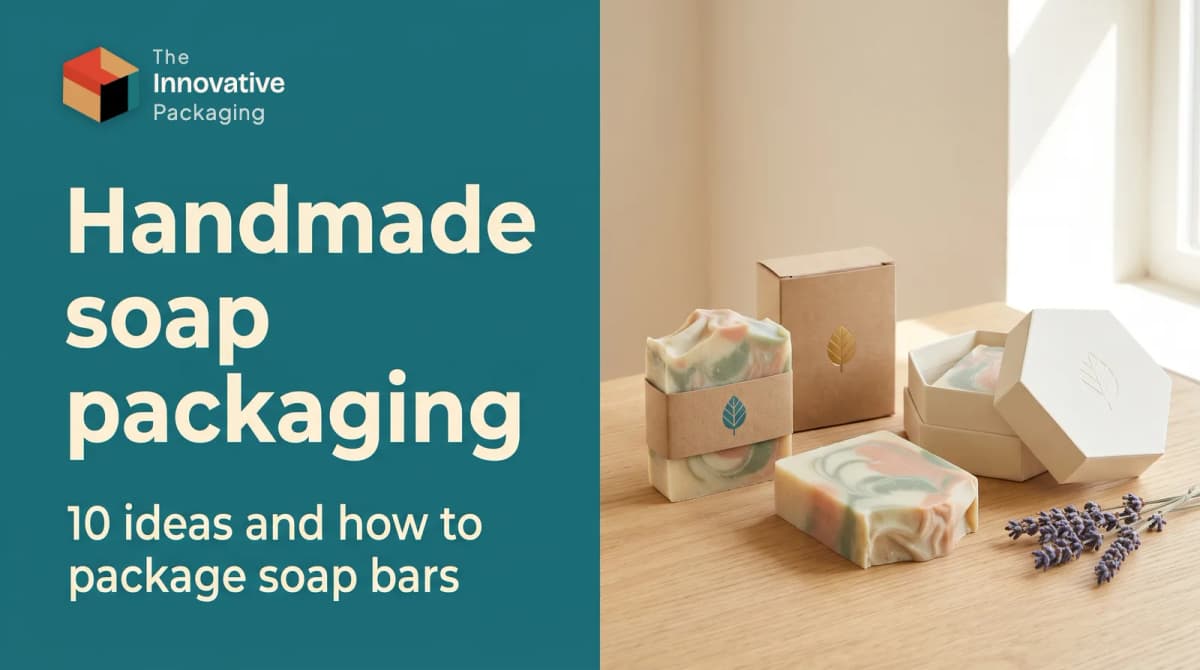
The best handmade soap packaging lets the bar breathe, fits bars that vary in size from batch to batch and leaves room for the label. For most cold-process soap, that means an uncoated kraft sleeve, wrap or box that lets moisture escape and the scent come through, rather than a sealed, laminated carton.
Soap is easy to over-package. A bar that is still curing carries moisture, and its strongest selling point, the scent, has to reach the customer before they open anything. This guide covers how to package soap bars, ten handmade soap packaging ideas, how to size the box and what the label needs to say.
How do you package handmade soap?
- Let the bar finish curing. Package cold-process soap only once it has cured, and choose packaging that still lets it breathe.
- Choose a structure. A sleeve, a paper wrap, a box with a vent or window, or a full carton, depending on how and where you sell.
- Size it to your largest bar. Handmade bars vary, so measure the biggest one from a recent batch.
- Plan the label. Decide whether your soap is a true soap or a cosmetic, because that sets what the label has to carry.
- Pick a finish that suits the material. On uncoated kraft, a debossed logo or simple line art usually looks better than full-color printing.
Should soap packaging breathe?
For cold-process soap, it helps. The chemical reaction that turns oils into soap finishes within hours, but the bar keeps losing water for weeks or months afterward. In one test by the soapmaking supplier Wholesale Supplies Plus, a bar fell from about 20 percent moisture to about 9 percent over 60 days, and it hardened as it dried (Wholesale Supplies Plus).
Seal that bar inside a laminated box and the moisture has nowhere to go. The bar can stay soft, and the damp can mark the board from the inside. Uncoated kraft and paperboard let the bar keep drying. Melt-and-pour and fully cured commercial bars are more stable and can go into a coated box without trouble.
Soapmakers do not all agree on how much breathing matters once a bar is fully cured. But while a bar is still drying, packaging that lets air in is the safer choice.
Breathable packaging has a second benefit: the customer can smell the soap on the shelf. For a product sold largely on scent, that often matters more than the design.
10 handmade soap packaging ideas
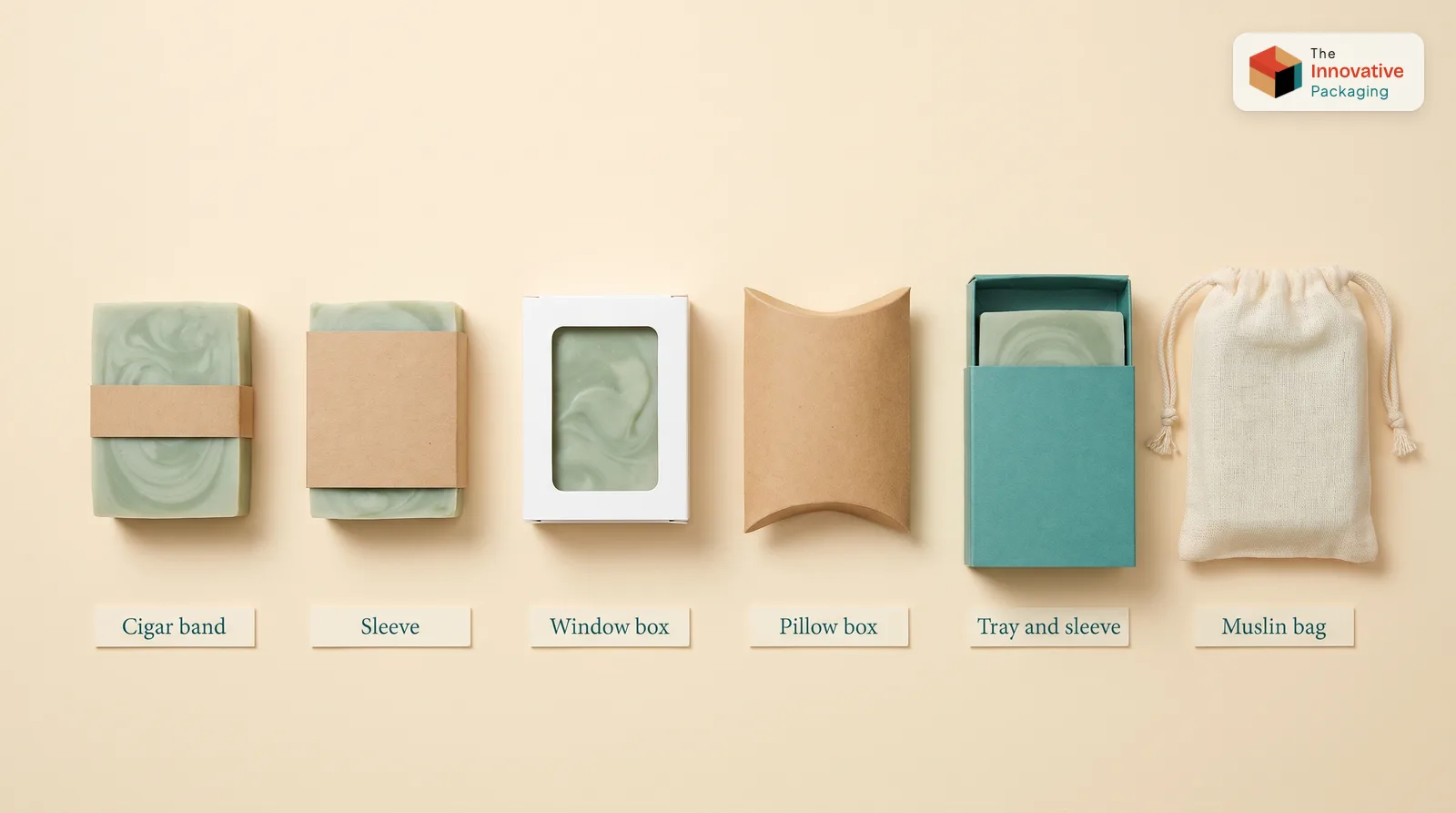
These are the soap packaging ideas that work best for small soap brands, from the simplest to the most premium.
| Packaging | Lets the bar breathe | Shows the bar | Best for |
|---|---|---|---|
| Cigar band | Yes | Mostly | Markets and small batches |
| Kraft sleeve | Yes, both ends open | Partly | Shops and everyday bars |
| Paper wrap | Yes | No | Low cost and seasonal scents |
| Window box | Partly | Yes | Swirled or colored bars |
| Tuck end carton | Only if uncoated | No | Retail shelves and shipping |
| Pillow box | Only if uncoated | No | Samples, favors and guest bars |
| Two-piece or hexagon box | Only if uncoated | When opened | Single gift bars |
| Tray and sleeve set | Only if uncoated | When opened | Sets of three to six bars |
| Muslin bag | Yes | Partly | Natural and zero-plastic brands |
| Clear or shrink wrap | No | Yes | Melt-and-pour and fully cured bars |
- A cigar band. A printed paper strip wrapped around the middle of the bar and glued at the back. It leaves most of the bar open to the air, it is quick to apply and it copes well when bars vary in size, which makes it a favorite with handmade soap makers.
- A kraft sleeve. A card sleeve that slides over the bar with both ends open. It breathes freely, lets the scent out and costs less than a full box.
- A paper wrap. The bar is wrapped in plain or printed paper and closed with a label. It is the cheapest option and suits small batches and seasonal scents.
- A window box. A die-cut window shows the color and swirl of the bar. Leave the window open so the bar can breathe, or back it with glassine or cellulose film for a paper-based alternative to plastic. Our window boxes can be cut to any bar shape.
- A tuck end carton. A straight tuck end box gives the most print area and the most protection, which helps on retail shelves and in the mail. Leave it uncoated if the soap is still drying.
- A pillow box. A small curved box that closes by folding in its ends. It suits sample bars, wedding favors and guest soaps, where the box is part of the gift.
- A two-piece or hexagon gift box. A hexagon two-piece box with a lift-off lid turns a single bar into a gift. An embossed or foil-stamped lid makes it feel special without coating the board.
- A tray and sleeve gift set. A tray and sleeve box with a partition holds three to six bars in separate cells, so they do not rub and the scents stay apart. Our guide to packaging inserts covers partition styles.
- A muslin bag. A cotton drawstring bag breathes and can be reused, which suits natural and zero-plastic brands. Add a printed tag for the label.
- Clear wrap or shrink wrap, for the right soap. Plastic film suits melt-and-pour soap, which can attract moisture from the air and form beads on its surface in humid weather. The soapmaking supplier Wholesale Supplies Plus recommends wrapping it tightly in clear film, while noting that cold-process soap should be allowed to breathe and does not need wrapping straight away (Wholesale Supplies Plus).
Selling at markets or in shops? A printed counter display holding a dozen banded or sleeved bars sells the range as a set. Brands ordering display boxes wholesale often match them to the sleeves. If you sell soap alongside bath bombs, our custom bath bomb boxes can match the same kraft look, and simple retail packaging boxes work for multipacks.
Which finishes work best on soap boxes?
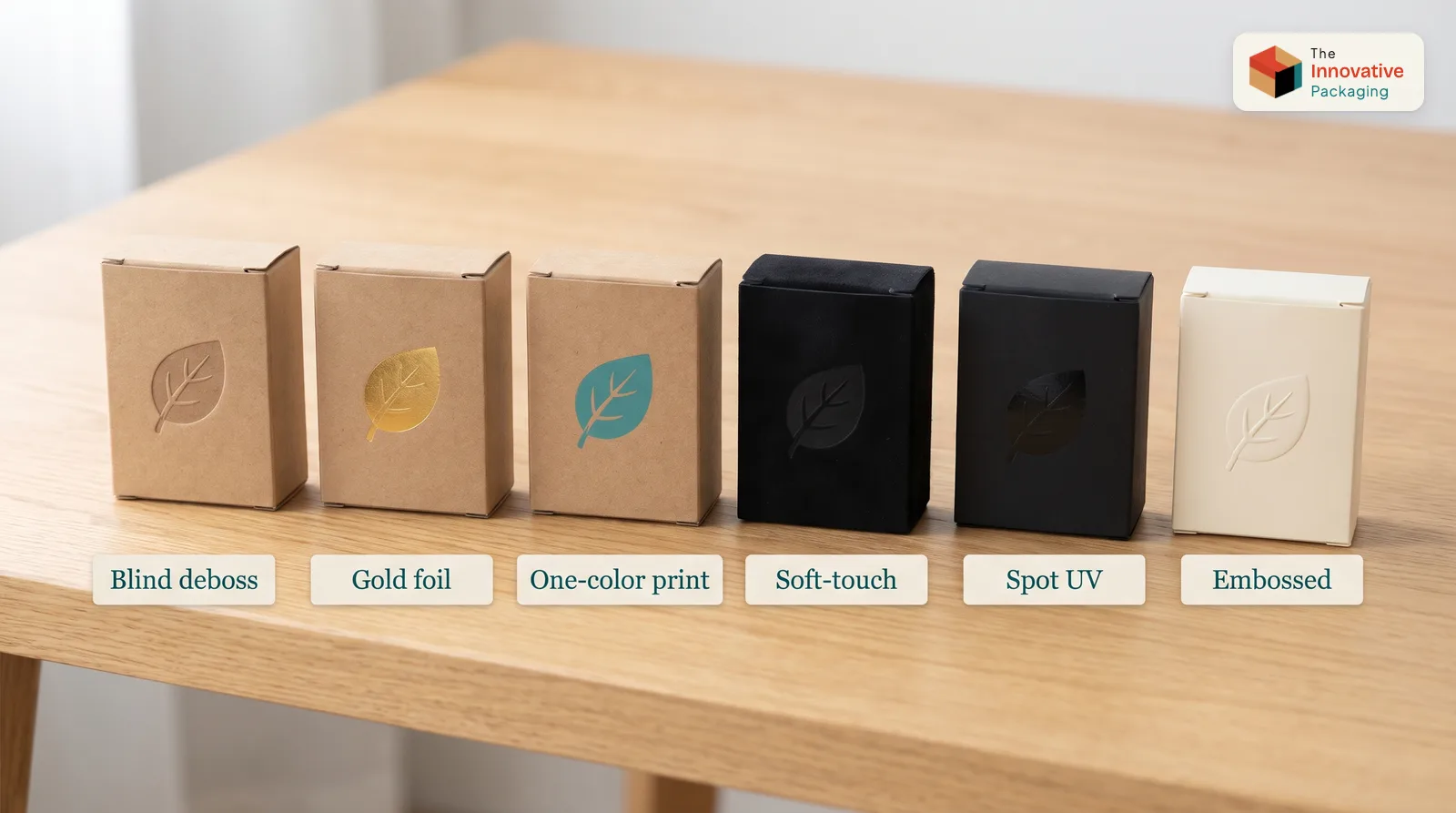
The finish matters more on soap than on most products, because some finishes seal the box and trap moisture in bars that are still drying.
| Finish | How it looks | Fine for soap that is still curing? | Best for |
|---|---|---|---|
| One-color print on uncoated kraft | Natural and handmade | Yes | Everyday bars and sleeves |
| Blind deboss or emboss | A pressed or raised logo with no ink | Yes | Natural and premium brands |
| Foil stamping | A metallic logo that stands out on kraft | Yes, but it adds a metallic layer to the box | Gift bars and holiday ranges |
| Die-cut window or vents, no film | Shows the color and swirl of the bar | Yes | Swirled and colorful bars |
| Soft-touch lamination | A velvety, luxury feel | No, it seals the board | Fully cured or melt-and-pour bars |
| Spot UV | A glossy highlight on a matte box | No, it is usually applied over a laminated or coated box | Luxury bars in printed boxes |
On uncoated kraft, a debossed logo catches the light against the rough surface. It looks premium, adds no coating and survives handling, which makes it the most useful finish for natural soap brands. If your bars are still curing, stay with the first four finishes and save lamination for melt-and-pour or fully cured soap. Our guides to matte vs gloss lamination and making packaging look expensive cover these finishes in more detail.
What size box do you need for a bar of soap?
Handmade bars are usually about 85 to 100 millimeters long, 55 to 65 millimeters wide and 25 to 35 millimeters deep. The bigger problem is that they vary from batch to batch. Loaf cuts drift by a few millimeters, and bars shrink slightly as they dry. A box cut to one perfect bar may not close on a thicker one from the next batch.
Measure the largest bar from a recent batch, not the average, and build a little tolerance into the dieline. A sleeve or cigar band is more forgiving than a box, because it only has to fit around the bar. Measure once the bars have cured, not straight after cutting, because they shrink a little as they dry.
What does a soap label need?
It depends on how your soap is made and what you say about it. Under FDA rules, a product counts as soap only if most of it is made of fats or oils combined with an alkali, that soap is what does the cleaning, and it is sold only as soap. Products that meet that definition are regulated by the Consumer Product Safety Commission, not the FDA (FDA).
Once you market the bar for other cosmetic uses, such as moisturizing the skin, acting as a deodorant or adding fragrance to the user, the FDA regulates it as a cosmetic. Claims such as "antibacterial" can make it a drug. Many handmade soaps are sold with at least one of these claims, so it is worth planning for cosmetic labeling from the start.
For cosmetics, the FDA's labeling guide sets out where each item goes (FDA Cosmetics Labeling Guide):
- Front panel: what the product is, in bold type, and the net quantity in the bottom 30 percent of the panel.
- Information panel: the ingredient list.
- Name and place of business: of the maker, packer or distributor, with a street address, city, state and ZIP code.
The FDA also notes that a post office box or website address alone does not meet the address requirement, and that ingredients must be listed by their common names without extra description, so a word like "natural" does not belong in the ingredient list (FDA small business fact sheet).
Weight needs extra care with handmade soap, because bars keep losing water after you label them. Wholesale Supplies Plus suggests weighing one bar from each batch every week until its weight stops falling, then labeling only bars that sit slightly above the stated weight. On a sleeve, you have fewer panels to work with, so put the brand and scent on the front and the ingredients and business details on the back.
This is a summary, not legal advice. Check the FDA guide, or the CPSC for true soap, before you print.
How do you package soap for shipping?
A sleeve or a paper wrap is made for a shelf, not a parcel. For online orders, put the wrapped bar inside a small custom mailer box or shipping box, sized so the bar cannot slide around, and add paper fill only where there is a gap. Keep coatings off the inner packaging if the bar is still drying, and avoid sealing it in plastic, which traps moisture during a long, warm trip.
Gift sets need more care, because bars rub against each other in transit. A partition or a fitted tray keeps each one in place.
What soap packaging mistakes should you avoid?
- Laminating packaging for soap that is still curing. It traps moisture and can mark the box.
- Sizing the box to an average bar. The thicker bars from the next batch will not fit.
- Making claims you have not planned for. Words like "moisturizing" change how the bar is regulated and what the label must carry.
- Printing photos on kraft. Kraft is brown, so colors sink into it and photos lose contrast. Line work, type and simple illustration print far better.
- Letting scented oil mark the print. Fragrance oil can stain kraft where the bar touches it. A small square of wax paper between the bar and the printed panel keeps the print clean.
- Forgetting the scent. A fully sealed package hides the one thing most shoppers want to check first.
Ordering custom soap boxes
To quote soap packaging, we need:
- The size of your largest bar from a recent batch
- Whether the soap is cold-process, hot-process or melt-and-pour
- The structure you want: a sleeve, a window box, a full carton or a gift set
- Your artwork, or a note on the finish you want, such as a debossed logo
- Roughly how many you need per scent
We make custom soap boxes and sleeves from 100 units per style, in uncoated kraft or printed board, with a digital proof before printing and free shipping anywhere in the USA. For a fully recyclable option, see our eco-friendly packaging boxes and the stock comparisons on our materials and printing page. Request a free quote for custom soap boxes.
Founder & CEO, The Innovative Packaging · 10 years experience
Ijlal Ahmed founded The Innovative Packaging and runs its production facility in Pakistan. He is the third generation of his family in printing and packaging, a business they have been in for more than 50 years, and works directly with brands on quotes and dielines. He holds a BSc in Economics from the Lahore School of Economics.
Ijlal Ahmed on LinkedInFrequently Asked Questions
Shop the packaging in this guide
Eco-Friendly Packaging Boxes
Looking for sustainable custom eco-friendly packaging boxes wholesale that reflect your brand's commitment to the environment? At The Innovative Packaging, we produce fully custom green packaging using kraft paper, recycled cardboard, and biodegradable materials tailored to your exact product dimensions and branding. Whether you need eco-friendly boxes for food, dates, baked goods, or general retail products, we have a sustainable packaging solution for every product in your lineup.
Browse Eco-Friendly Packaging Boxes →Custom Retail Boxes
Looking for high-quality custom retail packaging boxes wholesale that help your products stand out on shelves? At The Innovative Packaging, we produce fully custom retail boxes tailored to your brand identity, product dimensions, and retail environment. Whether you need packaging for cosmetics, food, paper bags, mailer boxes, or display packaging, we have a solution for every retail product in your lineup.
Browse Custom Retail Boxes →Custom Cosmetic Boxes
Looking for premium custom cosmetic boxes wholesale that make your beauty brand stand out? At The Innovative Packaging, we produce fully custom cosmetic packaging tailored to your exact product dimensions, branding, and retail requirements. Whether you need boxes for perfume, serum, lip gloss, hair products, essential oils, or face care kits, we have a packaging solution for every product in your beauty lineup.
Browse Custom Cosmetic Boxes →More from the blog
Packaging Inserts: Types, Examples and How to Choose the Right One
Packaging inserts hold a product in place and give the customer something to read when the box opens. Here are the main types of protective and printed inserts, examples by product and how to choose the right one.
Read more →8 Ways to Make Your Packaging Look Expensive on Any Budget
The most expensive-looking packaging is rarely the most expensive to make. Here is how to make packaging look premium on a small budget: a calmer design, heavier board, soft-touch lamination, one well-chosen finish and an unboxing worth remembering.
Read more →How to Choose Custom Cosmetic Boxes for Your Brand
Learn how to choose custom cosmetic boxes that reflect your brand identity, protect your products, and create a memorable unboxing experience.
Read more →