Frosted Bags for Clothing: A Guide to Frosted Zipper Bags for Apparel Brands
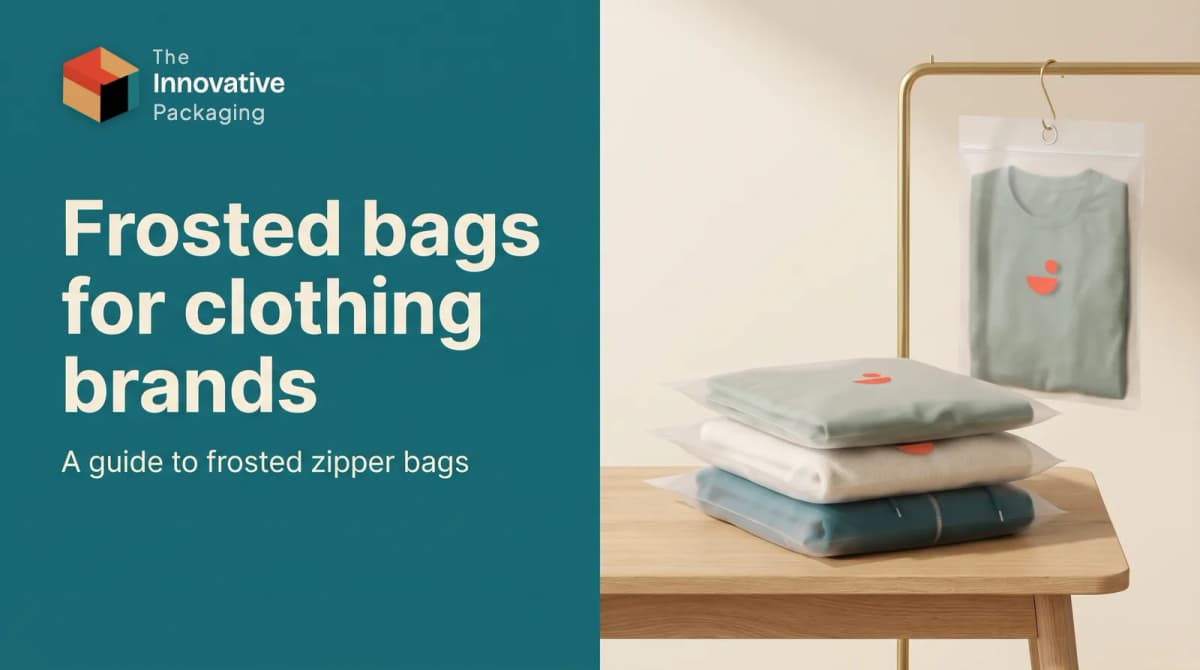
Frosted bags are semi-transparent plastic bags with a soft, matte surface. For clothing brands, the usual choice is the frosted zipper bag: a resealable bag that protects a folded garment, shows it as a soft shape behind the film and carries your logo.
It looks more considered than a clear poly bag, costs far less than a box and works both on a shelf and inside a shipping box. If you sell apparel, it is often the first thing a customer touches after opening the delivery. This guide to frosted bags for clothing, also sold as frosted poly bags or clothing packaging bags, covers what they are made of, how they compare with clear and opaque bags, and how to choose the right closure, size and print for your brand.
What are frosted bags made of?
Most frosted zipper bags for clothing are made from low-density polyethylene (LDPE) film, a type of polyethylene, which is the same family of plastic used in many grocery and produce bags. The frosted look comes from a matte texture on the film, which diffuses light so the garment inside appears soft and slightly blurred rather than sharp.
That material matters for recycling. LDPE film is labeled #4 plastic, and in the US, plastic bags and films are not accepted in most curbside recycling programs. Instead, they are collected at participating store drop-off points (How2Recycle). If you print a recycling message on your bag, say exactly that, rather than using a general recycling symbol customers may misread.
Should you choose frosted, clear or opaque bags?
The film you choose changes how your product looks and how much room you have for branding.
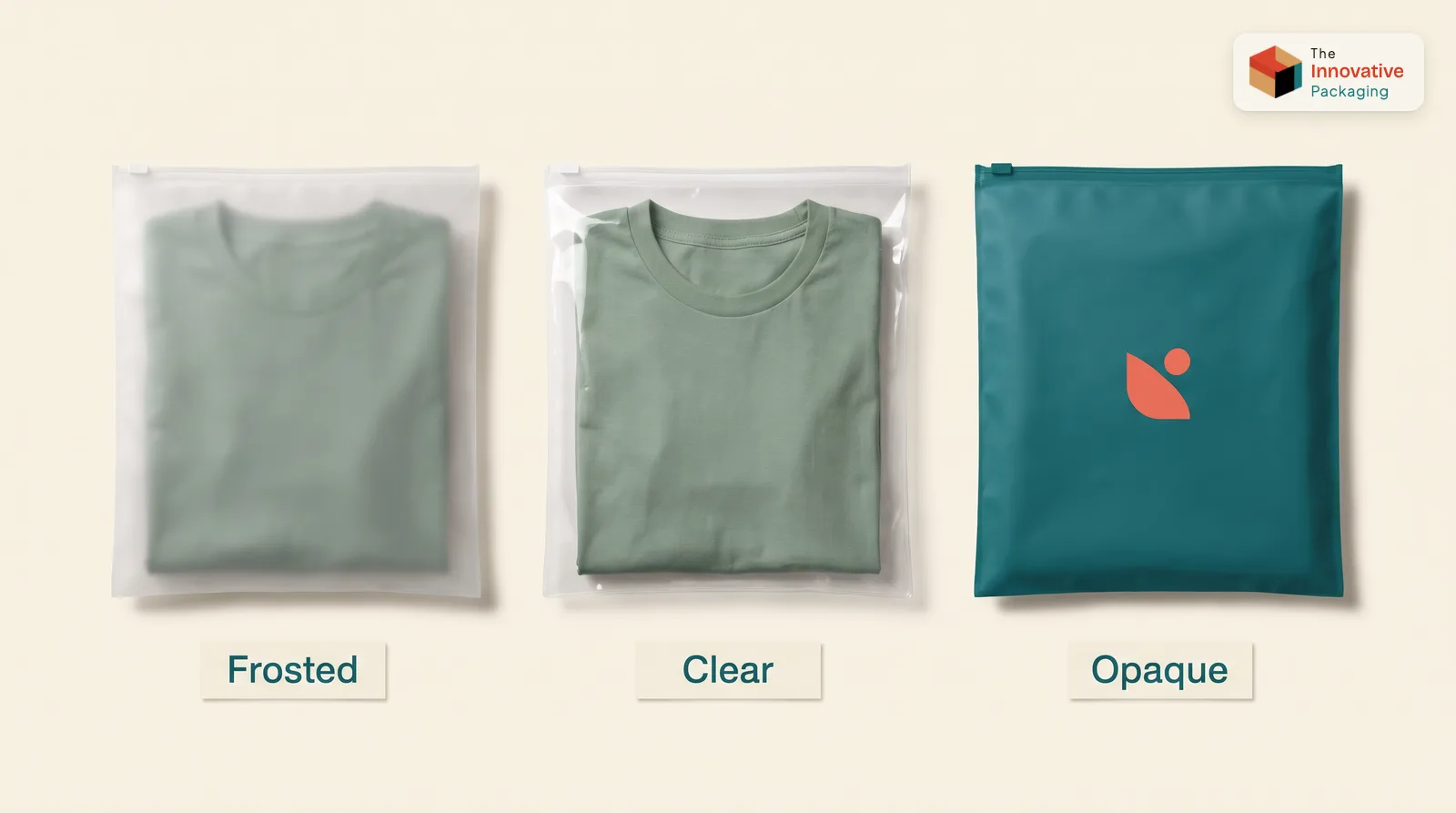
| Film | How the garment looks | Best for |
|---|---|---|
| Frosted | A soft, blurred shape behind the film | Most apparel brands that want a premium, minimal look |
| Clear | Fully visible, with exact color and fabric | Products where shoppers need to see the exact shade or pattern |
| Opaque | Completely hidden | Bold, fully printed bags and products that should stay private |
For most clothing brands, frosted is the sweet spot. It hints at what is inside, hides creases and small imperfections in the fold and gives printed artwork a calm, even background.
Why do clothing brands use frosted zipper bags?
- They look premium for little cost. A matte, branded bag reads as a deliberate choice, while a thin clear poly bag reads as stock.
- They protect the garment. The bag keeps dust and moisture off clothing in storage, in transit and on the shelf.
- They reseal. A zipper lets customers store the garment, or reuse the bag for travel, which keeps your logo in their hands long after the sale.
- They work online and in store. The same bag can sit inside a shipping box or hang on a retail wall.
- They carry your brand. A logo printed on one or both sides turns a basic bag into packaging.
Which closure should you choose?
The closure decides how the bag is used, so settle it before the artwork. There are four common options:
- Slide zipper. A rigid slider that opens and reseals with one hand. The best choice when you want customers to reuse the bag.
- Press-seal zip. An interlocking closure with a flat profile and a lower cost per bag. Good for online orders, where the bag is usually opened once.
- Gusseted bag. An expandable side or bottom panel for hoodies and knitwear that would strain a flat bag.
- Hang hole. A slot or round punch at the top so the bag can hang on a peg or boutique wall.
If the same garment sells online and in a shop, you may need two versions: a press-seal bag for web orders and a hang-hole bag for retail. Our custom frosted bags are available with all four closures.
What size frosted bag do you need?
Bag size follows the fold, so decide how your team folds each garment before you measure. As a rough guide, a folded T-shirt fits a bag of about 10 by 12 inches, and a folded hoodie a bag of about 14 by 18 inches. Knitwear and heavier fabrics fold much thicker than a cotton tee, so a single size rarely fits a whole range well.
Leave enough room for the garment to slide in easily. A bag cut too tight will not close cleanly over the zipper, and one cut too loose looks slack. The simplest route is to send a folded sample to your supplier and have the bag sized to it.
How do you print on frosted film?
Frosted film changes how colors look, because the garment shows through as a soft shape behind your artwork. A few rules help:
- A dark logo on a light garment reads easily. A light logo over a dark garment can disappear, so test white ink before you commit.
- Keep the design simple. One logo and a short line usually look better on frosted film than a busy pattern.
- Leave clear space beside the zipper track, so the closure does not cut through your artwork.
- Decide whether to print one side or both. A logo on both sides shows no matter how the bag lands on a shelf or in a box.
Do frosted bags need warning labels?
Sometimes, and it depends on the film thickness and where you sell. There is no federal suffocation warning rule for plastic bags, but five states (California, Massachusetts, New York, Rhode Island and Virginia) and two cities (New York City and Chicago) have their own, and these laws apply to bags thinner than 1 mil (Keller and Heckman, PackagingLaw.com). California's law, for example, covers plastic bags thinner than 0.001 inch that are large enough to fit over a child's head, and requires a warning that begins "CAUTION: KEEP AWAY FROM SMALL CHILDREN" (California Business and Professions Code, Section 22200).
Marketplaces can be stricter than the law. Amazon, for example, sets its own poly bag rules for products sent to its warehouses, including a printed suffocation warning on many bags. Ask your supplier for the film gauge, check the rules for every state and marketplace you sell through and plan space for the warning and any vent holes before you finalize the artwork.
The same care applies to environmental claims. The Federal Trade Commission's Green Guides say it is deceptive to misrepresent a package as recyclable, and that a recyclable claim should be qualified unless recycling facilities are available to at least 60 percent of the consumers or communities where the item is sold (16 CFR 260.12). For LDPE film, that means wording such as directing customers to store drop-off, rather than a broad "recyclable" or "eco-friendly" label you cannot back up.
Frosted bags for online orders
For online sales, the frosted bag usually travels inside a sturdier outer box. That combination works well: most shoppers prefer to receive online orders in boxes, with 77 percent choosing boxes over bags in a 2024 Ryder survey of 1,306 US online shoppers (Packaging Technology Today). The box protects the order in transit, and the branded bag inside gives the customer a second, more personal reveal.
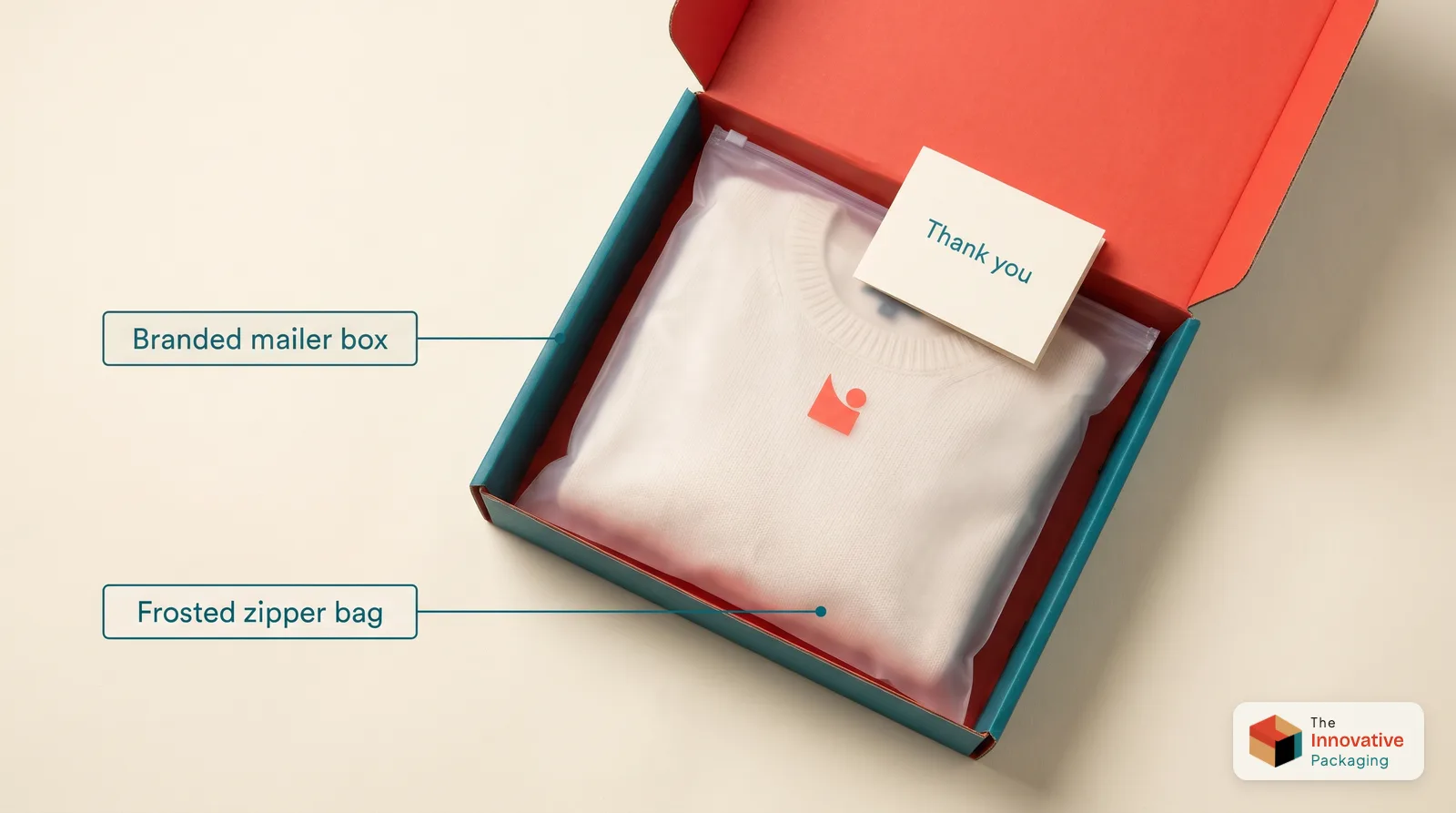
Pair your bags with a printed custom mailer box and the customer opens a branded box and then a branded bag. Our guide to ecommerce packaging covers the rest of the unboxing.
Frosted bags in retail stores
On a shelf or wall, the frosted bag is the first thing a shopper touches. A hang-hole bag keeps folded garments neat on pegs, and the printed front can carry the product line name and care details, which leaves less to fit on a hang tag. For the purchase itself, custom paper bags carry the same branding out of the store, and retail packaging boxes work for gift sets and accessories.
Ordering custom frosted zipper bags
To get an accurate quote, have these details ready:
- The garment type and its folded size
- The closure you need
- Frosted, clear or opaque film
- Your logo and print colors, and whether you want one or both sides printed
- Roughly how many bags you need per style
We make custom frosted zipper bags for clothing brands from 100 units per style, sized to your folded garment and printed in full color or matched Pantone colors. Every order includes a digital proof before printing, and shipping is free anywhere in the USA. Request a free quote for custom frosted zipper bags.
Founder & CEO, The Innovative Packaging · 10 years experience
Ijlal Ahmed founded The Innovative Packaging and runs its production facility in Pakistan. He is the third generation of his family in printing and packaging, a business they have been in for more than 50 years, and works directly with brands on quotes and dielines. He holds a BSc in Economics from the Lahore School of Economics.
Ijlal Ahmed on LinkedInFrequently Asked Questions
Shop the packaging in this guide
Custom Retail Boxes
Looking for high-quality custom retail packaging boxes wholesale that help your products stand out on shelves? At The Innovative Packaging, we produce fully custom retail boxes tailored to your brand identity, product dimensions, and retail environment. Whether you need packaging for cosmetics, food, paper bags, mailer boxes, or display packaging, we have a solution for every retail product in your lineup.
Browse Custom Retail Boxes →Eco-Friendly Packaging Boxes
Looking for sustainable custom eco-friendly packaging boxes wholesale that reflect your brand's commitment to the environment? At The Innovative Packaging, we produce fully custom green packaging using kraft paper, recycled cardboard, and biodegradable materials tailored to your exact product dimensions and branding. Whether you need eco-friendly boxes for food, dates, baked goods, or general retail products, we have a sustainable packaging solution for every product in your lineup.
Browse Eco-Friendly Packaging Boxes →Custom Gift Boxes
Looking for premium custom gift boxes wholesale that make every unboxing memorable? At The Innovative Packaging, we craft custom gift packaging tailored to your brand, product dimensions, and presentation requirements. Whether you need packaging for corporate gifts, retail products, luxury items, or seasonal collections, we have a solution for every occasion.
Browse Custom Gift Boxes →More from the blog
Your Box Is Your Storefront: Ecommerce Packaging That Sells
For online brands, the shipping box is the storefront. Here is how to build ecommerce packaging that protects every order, creates an unboxing experience worth sharing and brings customers back, even on a small budget.
Read more →Packaging Is Your Silent Salesman: A 10-Point Packaging Design Checklist
Packaging is your silent salesman, selling on every shelf when nobody else is there. Here is what good packaging design does, plus a 10-point checklist with a quick test for each point.
Read more →How to Prevent Shipping Damage and Reduce Returns With Better Packaging
A cracked bottle or a crushed corner turns a sale into a refund and a bad review. Here is how to prevent shipping damage and reduce returns with the right box size, custom inserts, stronger corrugated board, clear labels and a simple drop test.
Read more →